Who it’s for
The CAP 150 lb rubber hex set is for the beginner who has worked out that load is the thing you are actually buying, and who would rather own five pairs of dumbbells than one clever pair. It suits a spare room, a basement corner or a garage bay where there is room for a knee-high rack to live permanently, and it suits the person who wants to start training this week without learning a mechanism.
It is a particularly good fit for two situations that adjustable dumbbells handle badly. The first is a household with more than one lifter: two people on different weights can train side by side from one rack, which a single adjustable pair simply cannot do. The second is circuit and superset training, where the whole point is moving from one weight to the next without stopping - a fixed set makes that trivial and an adjustable pair makes it a chore.
Who should look elsewhere? Anyone whose binding constraint is floor space, and anyone who already knows they will be pressing heavy within the year. Ten dumbbells and a rack is a permanent installation, and 25 lb per hand is a real ceiling. If either of those is a problem, read our best adjustable dumbbells roundup before you spend anything here - a pair reaching 52.5 lb per hand costs similar money and occupies a fraction of the room. The full trade-off is laid out in adjustable vs. fixed dumbbells.
What you actually get
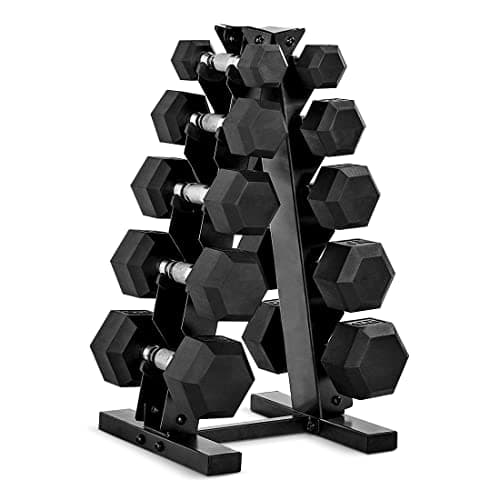
CAP publishes the contents plainly, which is more than many listings in this category manage: five pairs at 5, 10, 15, 20 and 25 lb- ten dumbbells, 150 lb of iron - plus an A-frame vertical rack. The heads are rubber-coated hex; the handles are knurled steel with a chrome finish on this version. The rack’s published footprint is roughly 14 by 13 inches at about 26 inches tall.
That ladder is the most important thing on this page, because it is what you will live with every session. Five-pound steps are small enough that progression feels continuous rather than like a cliff, and the five pairs between them cover the full range of what a dumbbell can do: the 5 and 10 lb pairs for lateral raises, rear delts and warm-ups; the 15 and 20 lb pairs for curls, overhead presses and Bulgarian split squats; the 25 lb pair for rows, bench press and goblet squats. Nothing in the box is decoration.
What is not in the box matters too. There is no bench, no bar, no plates and no mat. This is load and storage, nothing else - which is the correct way to buy it, but it means the set on its own gives you floor presses, curls and lunges rather than a complete gym. The purchase that doubles its usefulness is a bench, and almost any pick from our best adjustable weight benches roundup turns this rack into a full upper-body setup.
How the five pairs map to a week of training
The reason we keep calling this ladder “the right one” is easier to see if you lay it against an actual training week rather than a spec sheet. Here is where each pair earns its slot for a beginner following something like our full-body dumbbell workout.
- 5 lb pair - warm-ups, rear-delt raises, external rotations and the first few weeks of lateral raises. The pair nobody thinks they need and everyone uses.
- 10 lb pair - lateral raises once the 5s stop being hard, front raises, tricep extensions, and the weight you hand someone who has never trained before.
- 15 lb pair - curls, hammer curls, overhead presses for most beginners, and lunges while you are still learning to balance under load.
- 20 lb pair - dumbbell bench press, Romanian deadlifts, step-ups, and the pair that quietly becomes your default for most of the first year.
- 25 lb pair - rows, goblet squats, heavier presses and loaded carries. It is also the first pair you will outgrow, which is the whole argument of the next section.
Notice what that list does not contain: a pair that sits unused. That is not true of every set in this category - a 300 lb ladder that starts at 10 lb has no weight light enough for shoulder work, and a 56 lb neoprene set has nothing heavy enough to row. Five pairs at 5 lb intervals is the configuration where every single dumbbell in the rack has a job in a normal week, which is a better test of a set than its total poundage.
What it does well
It removes every excuse that involves faffing with equipment. This sounds like a small thing and it is not. The single most common reason people stop using home gym equipment is friction, and a fixed set has close to none: you reach down, you pick up the pair you want, you train. There is no dial to seat properly, no pin to find, no moment where a weight does not quite click in and you stop to check it. Over a year of training that adds up to a meaningful number of sessions that happened instead of being skipped.
The rubber coating earns its place three times over. It protects the floor when a tired set ends with a heavier set-down than you intended. It kills the ringing clang that bare iron makes - genuinely important in an apartment, a shared house, or any room above a space where someone is watching television. And it resists the light surface rust that bare cast iron picks up in a damp garage, which our rust-prevention guide covers in more detail. For a home gym specifically, coated iron is simply the better product.
The hex heads do the one job they exist for. Six flat faces mean a dumbbell stays exactly where you set it down. That sounds trivial until you have chased a round dumbbell under a bench mid-workout - which is the entire argument in our hex vs. round dumbbells guide. The flats also make the dumbbell a stable base for push-ups and renegade rows, which round heads cannot do safely at all.
And the rack is included, not an upsell. This is why we selected sets with storage for the whole dumbbell sets roundup. A set without a rack means ten dumbbells on the floor of a room you also walk through in the dark, and the aftermarket racks that fit a five-pair ladder cost a meaningful fraction of the set. Getting an A-frame in the box that holds all ten in about a square foot of floor is a real part of the value.
Where it falls short
Twenty-five pounds per hand is the ceiling, and you will meet it. This is the honest headline limitation and it is not a small one. Rowing is where it bites first: a reasonably fit adult can usually row more than 25 lb in each hand within a few months of consistent training, and from that point the heaviest pair in the set is no longer a challenging weight for your back. Dumbbell bench press follows. When that happens you cannot upgrade the set - you buy heavier pairs separately, or you buy a different set. Our guide to what weight dumbbells to start with is worth reading first precisely so you can decide whether 25 lb is your ceiling or your starting point.
Ten dumbbells is ten things. A rack keeps them tidy, but there is a tax to fixed sets that nobody mentions: every session ends with putting ten objects back in the right slots, and a half-racked A-frame looks and feels like clutter in a way a single pair of adjustables never does. If a tidy room matters to you more than it does to us, weigh that.
No small steps. Five-pound jumps are good for the big lifts and crude for the small ones. Going from a 5 lb to a 10 lb lateral raise is a 100% increase, which is a lot to ask of a shoulder - and there is no 7.5 lb pair to bridge it. Adjustable dumbbells with 2.5 lb increments genuinely do this better, and the workaround with a fixed set is to add reps and sets rather than weight, which our progressive overload guide explains.
It is a permanent installation. The rack does not fold, collapse or go in a cupboard. Unlike a bench or a folding rack, this set claims its patch of floor for as long as you own it. In a shared room or a space that reverts to being a bedroom at Christmas, that is a genuine drawback - and it is why our apartment home gym build recommends adjustables instead.
The verdict
The CAP 150 lb rubber hex set is the set we would buy for a first home gym, with eyes open about the ceiling. The reason is that it gets the beginner variables right rather than the spec-sheet ones: five pairs with 5 lb steps is exactly the range a new lifter needs for their first year, the rubber hex heads are the right construction for a house, and the included A-frame means the set does not become a trip hazard in week two. Nothing about it can break, and it will still be usable in twenty years.
Buy it if you have the floor for a permanent rack, you want load you never have to think about, and you are either starting from nothing or training alongside someone else. Buy the 12-sided version instead if it happens to be cheaper when you look - the pair ladder and the rack are identical and the difference is cosmetic. Step up to the 210 lb or 300 lb sets if you already know 25 lb is not going to hold you. And buy a pair of adjustable dumbbells instead if the room is small, the room is shared, or the plan is to get strong rather than to get started.
One last practical note: put something under the rack. Ten dumbbells on a loaded A-frame concentrates a lot of weight onto four small feet, and one mat solves the floor protection and most of the noise for very little money - our home gym mats roundup covers which mat goes under what.