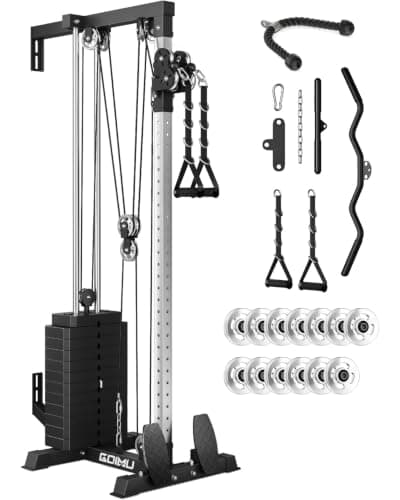
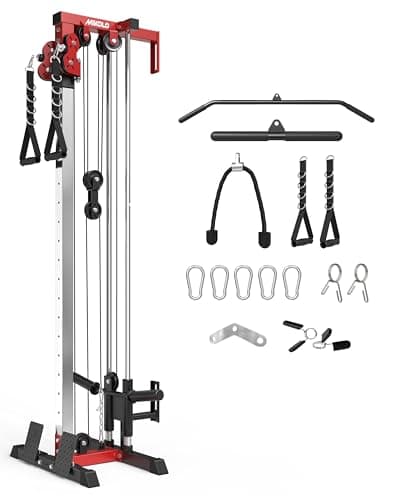
Start with where it mounts — not with the price
Every cable machine in this price range is one of three things, and the three are not interchangeable. Decide which one your room allows before you compare anything else, because it removes most of the market in a single step.
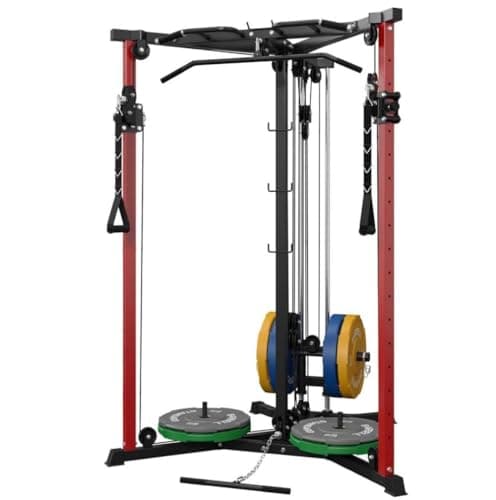
- Wall-mounted. The best value by a distance — bolting the frame to a wall does the stability work that a freestanding machine has to buy with steel and a wide base. You need a genuinely solid wall. Our top pick and the weight-stack pick are both this type, and the Goimu listing explicitly specifies concrete or masonry. If you have stud-framed drywall, or you rent, this whole category is out.
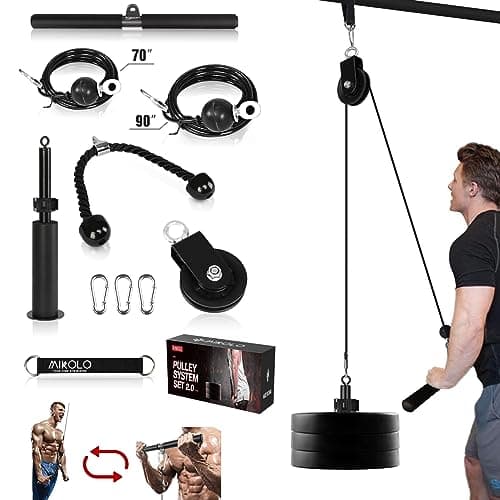
- Rack-mounted. A pulley and a loading pin that hang off a power rack, squat stand, pull-up bar or exposed beam. Cheapest by an order of magnitude, stores in a drawer, and completely dependent on already owning something to hang it from.
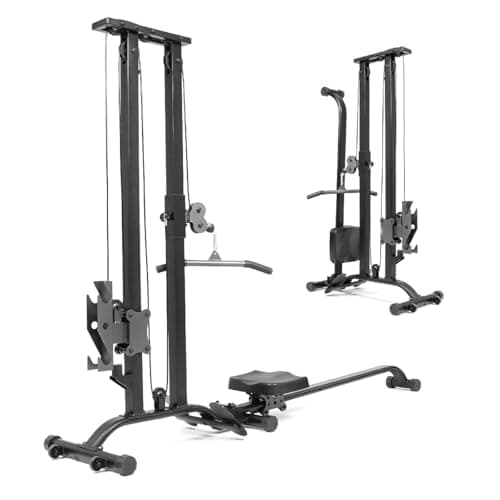
- Freestanding. Stands on its own base, no holes in anything. The renter’s answer and the only type you can take with you with no repair work. You pay for it in floor space, in frame weight, or in a narrower range of movements.
That is the whole decision tree for most readers. A renter in an apartment has two options on this page and should not spend time reading about the other four. If you’re not sure which camp your room is in, our home gym space guide walks through measuring a room properly before you buy anything into it.
Measure your ceiling before you measure anything else
This is the mistake that gets made most often, and it is expensive because a cable tower is not something you return easily. Lat pulldowns need the pulley above your seated reach, and most of these frames are 78 to 82 inches tall — which fits an 8-foot ceiling comfortably and a basement with ductwork not at all.
Measure floor to the lowest obstruction over the spot where the machine will live, not the highest point in the room. Joists, pipes, a garage door track when it’s open, and light fixtures all count. If the number comes back under about 7 feet, the TOUSAINS pick is the one on this page designed for you: at just under 63 inches tall it leaves roughly 21 inches of pulldown headroom under a standard 84-inch ceiling, by the listing’s own arithmetic. Everything else here will have you kneeling. Our minimum ceiling height guide covers the same problem for racks and pull-up bars.
Plate-loaded or a weight stack — the real cost difference
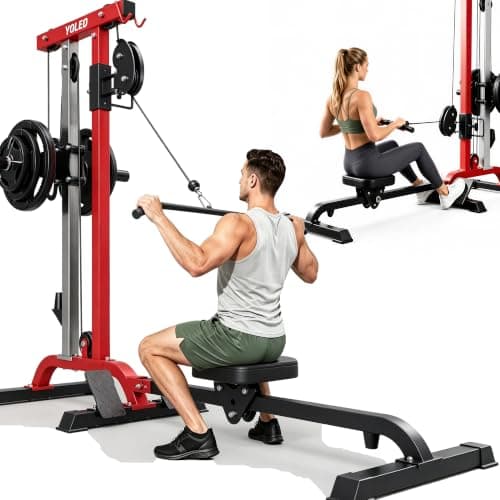
Five of our six picks are plate-loaded: you put weight plates (or in two cases, dumbbells) onto a loading pin. One has a selectorized weight stack, where you move a pin to pick the weight.
Plate-loaded is why these machines are cheap, and if you already own plates it is close to free capability. The cost is friction. Every weight change is a trip to the plate posts and back, which sounds trivial and is not: it is the difference between actually running drop sets and quietly deciding not to bother. The stack on the Goimu solves that for about double the money — and it still takes plates on a pin, so the 155 lb stack is a floor rather than a ceiling.
One more thing worth understanding before you compare capacity numbers: the cable ratio. On a 2:1 machine, 100 lb on the pin feels like 50 lb in your hand but moves twice as far; on 1:1 the weight is honest and the travel is shorter. Both the Goimu and the Mikolo wall station ship an adapter to switch between the two. It is a genuinely useful feature and also the reason a “400 lb capacity” claim needs reading carefully — and why, if you don’t own plates yet, you need to budget for them alongside the machine. Our weight plate guide covers what to buy and what a starting set costs.
What cables add that free weights don't
Worth being specific, because “versatility” is doing a lot of unearned work in this category’s marketing. A cable gives you constant tension through the whole range, which a dumbbell cannot — gravity only pulls down, so a dumbbell curl is hardest at one point and nearly free at the top. Cables also let you pull from angles a free weight has no way to load at all: a lat pulldown, a face pull, a cable fly, a tricep pushdown.
Practically, that means cables are outstanding for back width, rear delts, and arms — exactly the muscle groups a dumbbell-and-bench home gym under-serves. The lat pulldown alone justifies a lot of these purchases if you can’t yet do weighted pull-ups. See how to do pull-ups at home for the bodyweight route to the same muscle, and free weights vs. machines for where the two approaches genuinely differ.
What cables will not do is replace a squat, a deadlift, or a heavy press. No machine on this page loads your spine and hips the way a barbell does, and none of them is a substitute for a rack with working safety arms. If you’re choosing between a cable station and your first power rack or squat stand, buy the rack.
Check what's actually in the box
Attachments are where a cheap machine quietly stops being cheap. A lat bar, a tricep rope, a row bar and a pair of D-handles bought separately run real money, and a frame with no attachments is a frame you cannot use.
Every pick on this page includes attachments, which is partly why they are the picks. The Mikolo wall station ships a lat bar, cable bar and tricep rope; the YOLEO ships six pieces; even the $50 pulley system includes a straight bar and a rope. When you’re comparing against something not on this list, price the attachments in before you compare, and check the listing says included rather than compatible.
Two smaller things to look for in the specs. Pulley material: aluminum or steel pulleys on sealed bearings last and run quietly; bare plastic ones are the first thing to fail. Plate sleeve size: most of these take both 1-inch standard and 2-inch Olympic plates, but confirm it matches what you own, and see Olympic vs. standard if you’re not sure which you have.
Where this fits in a budget build
Honest placement: a cable machine is a second-phase purchase. Our $1,000 Build does not include one, and that is deliberate — the same money spent on a rack, a bar, plates, a bench and dumbbells buys more training for a beginner than any cable station does. Nothing on this page changes that order.
Where cables earn their place is once the foundation is there and you want to train back, rear delts and arms with more precision than a dumbbell allows. At that point the cheapest option is often the right one: if you already have a rack, the $50 pulley system adds pulldowns and pushdowns for the price of a pair of knee sleeves, and you can always upgrade to a station later. That is the sequence we lay out in how to upgrade your home gym, and the one we would follow ourselves.