Who it’s for
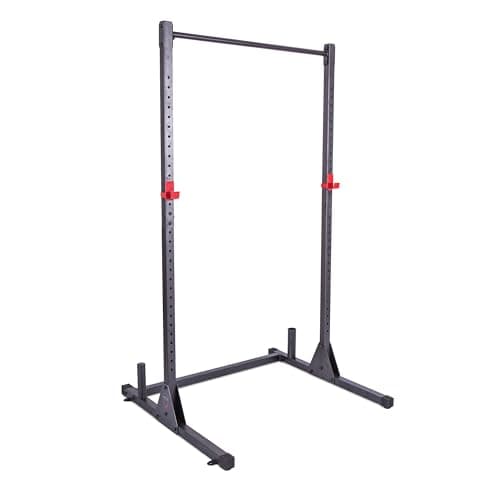
The CAP Barbell power rack is for the beginner who wants a real, enclosed four-post cageand wants to spend as little as possible getting one. CAP has been making budget strength gear for a long time, and this rack is the brand’s answer to the most common home-gym question: how do I squat and bench safely, alone, without buying the most expensive thing in the room? It bundles a pull-up bar and basic attachmentsinto a genuine cage frame for close to the least money a cage costs. If your budget is the tightest constraint but you still want the safety of a full cage rather than a two-post stand, this is the rack aimed at you. It won’t suit the lifter who already knows they’ll be loading a bar near the top of its rating every week — that person wants heavier steel — but for a first cage that lets a beginner train the big lifts safely, it’s hard to argue with the price. See where it sits against pricier options in our best power racks & squat stands guide.
The specs that matter
The important thing here is what you get for the price: a full four-post rack with safety catches, a pull-up bar, and basic attachments, from a brand that has been selling budget iron for years. That’s a lot of rack in one box. The pull-up bar adds the single best upper-back exercise with no extra footprint, and the attachments broaden what you can do inside the frame beyond squats and presses. The spec sheet is honest about the trade that makes the low price possible: the steel is lighter-gaugethan a premium rack’s. That’s the one number a shopper should weigh, and it’s the right trade for the job — for a beginner loading a barbell with plates rather than chasing a personal best, that gauge is enough to do the core lifts safely. Slot an adjustable bench inside it and you have a complete pressing and pulling station: squats and presses off the J-hooks, bench presses from the bench, and pull-ups from the top bar, all in one frame.
Safety for solo lifting
The reason a cage is worth it for a solo lifter is the safety catches, and this is a genuine enclosed cage, not a stand with an add-on. Set the catches just below the bottom of your squat or bench press and a rep you can’t finish comes to rest on the catches rather than on you — the whole point of an enclosed frame, and the thing that separates confident solo training from real risk. Lifting a loaded barbell with no one to spot and nothing to catch a miss is the most common way people get hurt at home, and a four-post cage is the most complete answer to that problem. Because the steel is lighter-gauge, it’s worth respecting the rack’s rated capacity and adding weight gradually rather than testing its limits — treat the rating as a ceiling, not a target. But for a beginner’s loads, the catches do exactly what a beginner needs them to do. Make setting them at working height the first step of every session, and the cage removes the single biggest danger of training alone.
What owners report
Owners tend to describe this rack the way the spec sheet does: a lot of cage for very little money. The value is the headline — people are surprised to get a full four-post frame with a pull-up bar and attachments at this price — and the safety catches get credit for making solo squats and presses feel secure. The recurring caveats are the two honest ones on the spec sheet: the steel is lighter than a premium rack’s, so it’s not built for someone chasing very heavy numbers, and the assembly takes patience— a fair number of bolts and an hour or two of careful work. For anyone whose first priority is getting into a real cage without overspending, those are exactly the trade-offs you’d expect to make, and most owners make them happily rather than reluctantly.
What you’ll pair it with
The rack is the frame; a few pieces turn it into a working gym. You’ll want a barbell, a set of plates, and an adjustable bench that slides inside to bench press — the cage gives you squats, presses, and pull-ups on its own, but the bench is what unlocks pressing. A rubber mat under the rack protects the floor, gives the base a steady footing, and softens the sound of plates being racked. Because this rack is the budget pick, it leaves more of the total budget for those extras, which is part of its appeal for a first build. We cost the whole setup — rack, bar, bench, plates, and flooring — in the $1,000 Build, so you can see how a cheap cage frees up money for the pieces around it.
Setting it up
Set aside real time for the build. A full cage means a fair number of bolts, and the spec sheet is upfront that assembly takes patience — so treat it as an afternoon job, ideally with a second person to hold the uprights square while you start the hardware. Lay your mat down first, stand the frame on it, and only fully tighten once everything is loosely threaded and aligned; chasing a cross-threaded bolt after the cage is torqued is the main way people lose an hour. It helps to dry-fit the pull-up bar and attachments loosely before the final tightening, so you can square the whole frame at once. With lighter-gauge steel, a couple of things matter more than usual: get every bolt properly snug, keep the frame on a level surface, and consider anchoring or loading the base for your heaviest sets so nothing shifts. None of it is difficult — it just rewards care. And keep the small hardware organized as you go, since sorting bolts by size at the start saves more time than it seems. Once it’s together and tight, you’ve got a real cage that will handle a beginner’s training for years, and the assembly becomes a one-time memory rather than a recurring chore.
Where it falls short
The two honest limits are gauge and assembly. The lighter-gauge steel is what keeps the price down, and it means this isn’t the rack for a lifter planning to load it near the top of its rating week after week — a heavier, pricier cage is the pick there. And the build takes patience: expect a couple of hours and an easier time with a helper to line up and hold the uprights. Neither is a dealbreaker for the person this rack is for, but both are real. If you want stiffer steel and more attachments, you’re looking at spending meaningfully more; if you want the absolute smallest footprint, a folding wall-mounted rack is the answer. For the beginner who wants a cage and a low bill, these limits are the reasonable cost of the price — and once it’s bolted together, it does the job for years.
How it compares
The natural step up is the SPORTSROYALS power rack, which adds a built-in cable pulley for pulldowns and rows — more money and more space, but a lot more exercises inside the same footprint. If you want the same enclosed safety without a cable stack, a straightforward multi-function cage with dip handles and a landmine sits in between on price and features. And if the room simply can’t give up a corner, a folding wall-mounted rack swings flat against the wall between sessions, trading some rigidity for the smallest footprint. We line all of them up in the best power racks & squat standsguide, and if you’re still weighing a cage against a simpler two-post stand, our squat stand vs. power rackguide breaks the decision down so you don’t overbuy or underbuy.
The verdict
The CAP Barbell power rack does one thing extremely well: it gets a beginner into a real, enclosed cage — with safety catches, a pull-up bar, and attachments — for close to the least money a cage costs. The lighter-gauge steel and the patient assembly are the price of that low price, and for a beginner’s loads they’re trades worth making rather than reasons to spend more. If your budget is the tightest part of the plan and you still want the safety of a full cage, this is the rack. Pair it with a bench, a bar, and plates, and see how a cheap cage fits into a complete setup in our $1,000 Build.