Who it’s for
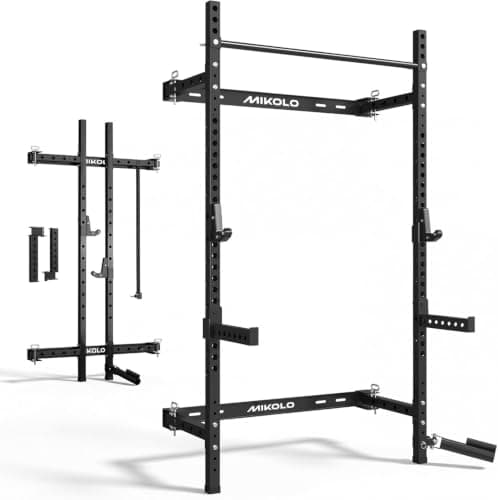
The Mikolo folding wall-mounted rack is for the lifter whose floor has to do more than one job. If your gym is a garage that still parks a car, or a spare room that can’t give up a permanent corner, this is the rack built for that exact problem: it bolts to the wall and swings flat to a few inches deepwhen you’re done, handing the floor back between sessions. It’s the answer for the space-constrained beginner who refuses to choose between lifting a real barbell and keeping the room usable. The one requirement is that you can drill into solid structure, which makes it a homeowner’s pick more than a renter’s — if you can’t put holes in the wall, a free-standing stand is the better route. But if you own the space and the shortage is floor area rather than wall, it solves the puzzle neatly. It pairs naturally with the thinking in our apartment home gym guide, which is all about training big lifts in small footprints.
The specs that matter
Two numbers on the spec sheet do the talking. The first is the steel: 2 in x 2 in uprights, heavier-gauge than most budget stands, which is what keeps a wall-mounted rack from feeling flimsy under a loaded bar. The second is the 1,000 lb rating — far more capacity than a beginner will approach for years, and a reassuring margin for a rack that folds. The defining feature, of course, is the folding wall mount: the frame swings flat against the wallto reclaim the floor, then swings back out when it’s time to lift. That combination — real steel, a serious rating, and a footprint that all but vanishes — is unusual, and it’s why this style of rack has become the go-to for tight garages. It’s worth being clear-eyed about what a folding rack is for, though: it’s a squat and press station that stores away, not a sprawling cage with a rack of attachments. If you’re planning the room around it, our home gym setup guide covers laying out flooring and clearance around a rack so the fold-away trick actually works in practice.
Safety and a solid anchor
A wall-mounted rack lives or dies on how well it’s anchored, and that’s the safety story here. Because it bolts into wall studs, the wall itself becomes part of the frame — done right, that makes a folding rack feel remarkably planted for its size, since it can’t tip the way a lightly loaded free-standing stand can. The flip side is that the install is permanent, so this only works where you can drill into solid structure: find real studs, use the proper hardware, and don’t improvise a mount into drywall alone, because the anchor is doing real work every rep. The heavier 2 in x 2 in steel and the 1,000 lb ratinggive you a solid, rigid base once it’s up. As with any barbell rack used alone, add weight gradually, treat the rating as a ceiling rather than a target, and only take on loads you could safely bail if a rep stalls. A secure anchor and a sensible load are what keep solo training safe on a rack like this, so the install is not a corner to cut.
What owners report
The praise owners give this style of rack tracks the spec sheet closely. The space saving is the headline — being able to fold the rack away and park a car or reclaim the room is the reason people buy it, and by all accounts it delivers. The 2x2 steelearns comments for feeling sturdier than the thin tubing on cheap free-standing stands, which is exactly what you’d hope from the heavier gauge. The recurring caution is the mounting: it has to go into real studs, and because the install is permanent, owners stress measuring and planning the location carefully the first time so you don’t end up drilling twice. The other practical note is the one already on the spec sheet — even folded, it still needs a clear stretch of wall, so you can’t tuck it behind shelving or a workbench. For the right space, none of that dims the appeal.
What you’ll pair it with
The rack handles the barbell; the rest of the gym is a short list. You’ll add a barbell and plates, and an adjustable bench that you roll or carry into place for pressing and roll away again — which fits the fold-away spirit of the setup perfectly, since nothing has to stay parked on the floor. A rubber mat under the lifting area protects the concrete and steadies your footing, and it’s easy to keep a bench and mat in a space that doubles as a garage. Because the rack itself reclaims the floor, the whole gym can pack down when you’re done. We cost the pieces out — rack, bar, bench, plates, and flooring — in the $1,000 Build, so you can plan a complete small-space gym rather than buying piecemeal.
Mounting it right
Because everything rests on the anchor, the mounting is the part to get right. Find your studs with a reliable stud finder and mark them — on a finished wall you’re bolting into the framing behind the drywall, not the drywall itself, so the hardware has to reach solid wood or steel. Hold the rack at your working height, level it, and mark every hole before you drill; measuring twice here saves you from a second set of holes you can’t hide. Use fasteners suited to your wall type and torque them fully, because the anchor carries real load on every rep. Once it’s fixed, test the fold-out and fold-flat action with an empty bar to confirm it clears the floor and swings freely, then load it, starting light for the first sessions. It also pays to plan where a bench and mat will live so the whole gym can pack down, not just the rack. Done carefully, the install is a single afternoon that turns a bare wall into a rack you can trust — and tuck away flat when the car needs the space back.
Where it falls short
The honest limits are both about the wall. First, the install is permanent: you bolt it into studs, which rules it out for renters who can’t drill and for any wall that isn’t solid structure. Second, folding flat still needs a clear wall— the rack reclaims the floor, not the wall it lives on, so you need an unobstructed run for it to fold against. There’s also less versatility than a full cage: this is a squat-and-press station, not a frame you can hang a cable stack and a dozen attachments on. If you can’t drill, or you want to move the rack around, a free-standing stand is the better answer. But if you own the space and the problem is floor area, these limits are exactly the trade you make to get a real rack that disappears when you’re done — and for the right room, it’s a trade worth making.
How it compares
The clearest alternative is a free-standing stand like the YOLEO squat rack, which needs no drilling and can be moved — the right call for renters, at the cost of taking up floor space full time. If you have a corner to give up permanently and want the enclosed safety of four posts plus room for attachments, a full cage is the step up in stability and versatility, though it won’t fold away. This Mikolo splits the difference: wall-mounted permanence in exchange for the smallest footprint of any rack we cover, which is why it scores top marks on space fit. We line the whole field up in the best power racks & squat standsguide, and the stand-versus-cage decision is worth thinking through before you commit to a permanent wall mount — it’s the difference between a rack you can move and one that lives where you bolt it.
The verdict
The Mikolo folding wall-mounted rack solves a problem nothing else solves as neatly: how to lift a real barbell in a space that has to be something else the rest of the day. Heavier 2x2 steel and a 1,000 lb rating give it real substance; the folding wall mount hands the floor back between sessions. You pay for that with a permanent install and the need for a clear, solid wall — reasonable costs if you own the space, dealbreakers if you can’t drill. For the garage that still parks a car, this is the rack. See how it fits into a complete small-space setup, alongside a bar, bench, and plates, in our $1,000 Build.