Who it’s for
The NÜOBELL 5–80 is for the beginner who already suspects they’re in this for the long haul. Most first-timers buy a dumbbell set with a 50 lb ceiling, make steady progress, and then run headlong into that ceiling on rows, goblet squats, and heavier presses within a year or two. At that point they either stall or buy a second, heavier set. The NÜOBELL sidesteps the whole problem by handing you up to 80 lb in each hand from the day it arrives.
Just as important, it never forces you to start heavy. The dial bottoms out at 5 lb, so a true beginner can train light and safe for as long as they need to, then keep climbing on the same pair. Think of the 80 lb top end not as weight you have to move on day one, but as headroom— the reason this set stays on your rack for years instead of getting sold on. If you want the plain-English rundown of every option first, our best adjustable dumbbells roundup lays them out from cheapest to go-heavy, and this is the one we point confident beginners toward.
A quick reality check on who should look elsewhere. If you’re still unsure the home-training habit will stick, or the budget is genuinely tight, a lighter or cheaper dial set will get you moving for less and you can always upgrade later — the NÜOBELL earns its price by lasting, so it makes little sense as a hedge. But if you already train with some regularity, or you’ve used a gym before and know a 50 lb dumbbell won’t hold you for long, this is the set that spares you the second purchase.
The specs that matter
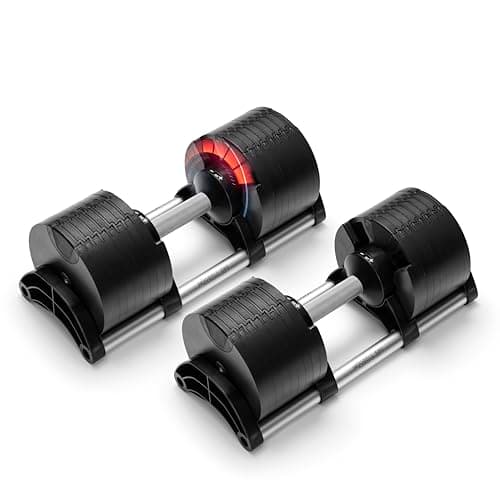
Three things on the spec sheet do the heavy lifting. The first is the 5–80 lb range per hand. That single figure is why the NÜOBELL exists: it replaces a wall of fixed dumbbells and outlasts almost any beginner’s progress curve. Where a 52.5 lb set becomes a limiter, this one keeps giving.
The second is the twist-handle dial. You set the number, lift the handle out of the cradle, and the plates you didn’t select stay behind — the same fast, tool-free weight change that makes dial dumbbells so friendly for beginners who don’t want to fuss with collars and loose plates between sets. If you’re still weighing the whole category against a rack of fixed weights, our guide on adjustable vs fixed dumbbells explains the trade-offs in detail.
The third is the metal handle and compact profile. On paper this reads like a small detail; in the hand it’s the difference-maker. A traditional round shape and a real metal grip feel far closer to the dumbbells you’d pick up at a commercial gym than the longer, plastic-shrouded budget units do — and because it’s compact for the weight it holds, it doesn’t swallow shelf space just to store 80 lb a side.
Put those three specs together and the practical payoff is simple: one pair on the corner of your rack replaces an entire wall of fixed dumbbells, from 5 lb up to 80 lb in small steps. For an apartment or a shared garage, that’s the difference between needing a dedicated dumbbell rack and tucking a single cradle against the wall. It’s worth deciding where the pair will live before it arrives, because a compact footprint only helps once you give it a home.
What owners report
We don’t test equipment in a lab, so what follows is drawn from the spec sheet and the pattern of what long-term owners say — not our own bench numbers. The most common theme is the feel: people who’ve owned both a plastic-dial set and the NÜOBELL almost always describe the metal-handled, round NÜOBELL as the one that feels like an actual dumbbell. For a beginner still building confidence, that familiarity matters more than it sounds — it keeps your focus on the lift, not on an awkward grip.
The second thing owners point to is durability. This is a set that’s built to the higher end of the category, and it earns a top mark from us on build quality for exactly that reason. The third is how far the range carries them: reviewers routinely note that the 80 lb ceiling means they simply stopped shopping for dumbbells — there was nowhere left to grow into. As with any dial dumbbell, the sensible-handling caveat applies: set the weight fully before you lift out, and don’t drop them. Treated with basic care, this is a buy-once pair.
One practical note that comes up often: there’s a short learning curve to seating and releasing the plates cleanly, as with any dial dumbbell. It clicks within a session or two, and after that the change-over is second nature. The other recurring comment is quiet confidence in the mechanism — once you’re used to hearing the plates settle into place, you stop thinking about it and simply train.
Where it falls short
The honest knocks are about price and fit, not quality. The clearest one is cost: the NÜOBELL runs roughly double the price of a 52.5 lb set. It’s a premium pick, and for a first-week beginner on a tight budget that premium can be hard to justify when a cheaper dial set would carry them for a good while.
The related point is that it’s simply more dumbbell than a day-one beginner needs. If you’re genuinely unsure whether you’ll stick with training at home, paying up for 80 lb of ceiling you may not touch for a year is money you could hold onto. There’s no shame in starting lighter and cheaper to find out if the habit sticks first — that’s a real strategy, not a compromise. The NÜOBELL rewards commitment; it doesn’t create it.
There’s also a mild caveat shared by every dial dumbbell: they’re bulkier per-dumbbell than a plain fixed weight of the same number, because the mechanism and the plates you didn’t select travel with you. It’s never a problem in use, but a dial unit set to 30 lb is a longer object than a single fixed 30 lb dumbbell. For nearly everyone that’s a non-issue — it’s only worth flagging so nothing about the shape surprises you out of the box.
How it compares
The obvious rival is the Bowflex SelectTech 552, the dial-adjust benchmark that most beginners land on first. The Bowflex tops out at 52.5 lb and costs noticeably less, which makes it the safer default for a cautious first purchase. The NÜOBELL asks for more money but answers with a higher ceiling and a metal handle that feels closer to fixed dumbbells. We put the two head to head in Bowflex vs NÜOBELL if you want the full breakdown before you commit.
Below both sits the value lane — a plate-loaded CAP set or a light 25 lb starter pair — for beginners who want the lowest cost of entry and don’t mind a lower ceiling or slower weight changes. Above the NÜOBELL there really isn’t much for a home lifter to chase; at 80 lb a hand you’ve reached the point where the next step is a barbell, not bigger dumbbells. You can see how every option stacks up in our adjustable dumbbells roundup, where the NÜOBELL is our pick for going heavier.
It’s worth remembering, too, that a dumbbell set is only half of an upper-body gym. Whatever pair you choose, you’ll get far more from it with a bench to press and row on — and the NÜOBELL’s heavier top end in particular unlocks dumbbell bench press, split squats, and rows that a bench makes possible. If you’re assembling the whole kit rather than a single piece, our home gym essentials guide covers the short list of what to own first.
The verdict
The NÜOBELL 5–80 is the adjustable dumbbell for the beginner who’d rather buy the right thing once than buy twice. It costs more up front, but the 80 lb range, the metal handle, and the genuinely high build quality mean it stays useful long after a 50 lb set would have topped out. If you’re confident you’ll train consistently, that’s money well spent.
In a full sub-$1,000 setup, dumbbells are usually the anchor purchase, and this is the pair to pick when the budget can stretch to it — pair it with a good bench and you have a complete upper-body gym in a corner. See how the numbers work in our $1,000 Build, and if you’re still assembling the shortlist of what to own first, our best home gym equipment for beginnersguide shows where a set like this fits. Spend less only if the budget is tight or you’re still testing the habit; if you already know you’re in, the NÜOBELL is the one that won’t hold you back.
Pair it with a sturdy adjustable bench and you’ve built a genuinely capable upper-body gym in a footprint smaller than an armchair. From there, the natural next step for most beginners is a barbell and a rack for the big lower-body lifts — but that’s a later purchase, and this pair will still be earning its keep long after you make it.