Who it’s for
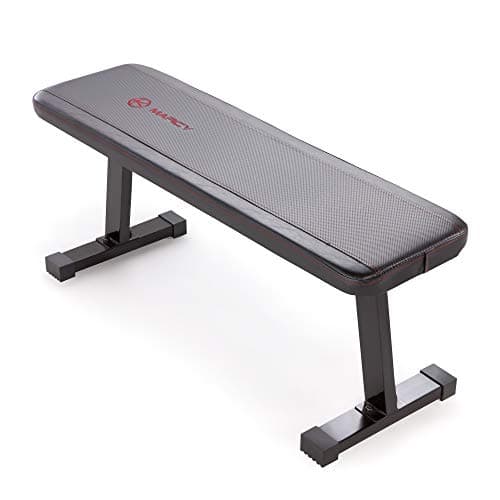
The Marcy flat utility bench is for the beginner who has done the honest thinking and decided they only want to press and row. No incline experiments, no decline sit-ups — just a steady surface for the bench press, dumbbell work, rows, and step-ups. If that is genuinely all you plan to do, a flat bench is not a compromise; it is the smarter, cheaper, sturdier tool for the job. Because nothing on it moves or adjusts, it does not have the small wobble that budget adjustable benches can develop at the seat-to-back gap, and for a lot of people that solid, planted feel is worth more than a handful of angles they would rarely use. It suits the minimalist setup where the priority is a great bench press and a strong back, and it slots comfortably into a full $1,000 buildas a no-drama foundation piece. Where it is the wrong pick is if you know you want incline pressing for your shoulders and upper chest — in that case an adjustable bench is the better buy, and we cover that path below and in our bench roundup.
It is worth being concrete about what this bench actually lets you train, because that is the whole decision. Flat pressing builds the chest, shoulders, and triceps; rows and chest-supported rows build the back; and the sturdy pad doubles as a platform for step-ups, split squats, and dumbbell work. That covers a large slice of a sensible beginner workouton its own. What it will not do is angle up for incline presses — so if your program leans on those, read the next section honestly before you buy, because this is the one thing a flat bench simply cannot give you.
The specs that matter
There are only a few numbers here, and that simplicity is the point. The spec sheet lists a 600 lb capacity— the total of your bodyweight plus the loaded bar — which is comfortably beyond anything a beginner will press or row. The design is flat only, with no moving joints, and that is precisely why the bench feels so stable: every wobble that an adjustable bench introduces at its hinge simply does not exist here. The last spec is the compact, fixed footprint: it does not fold, but it tucks into a corner and stays there, always ready to use. For a beginner, the specs that matter on a bench are stability and a capacity you will never worry about, and a good flat bench delivers both by doing less. If you are weighing this simplicity against the versatility of angles, our flat vs adjustable bench guide lays the two approaches side by side so you can decide which one actually fits how you will train.
There is a quiet safety benefit hidden in that fixed frame, too. Because nothing on the bench pivots or locks into a notch, there is no adjustment mechanism to shift under load, which is one less thing to think about when you are pressing. As with any bench, barbell pressing still belongs inside a squat stand or power rackwith the safety arms set — never over a bench alone — but paired with a rack, a rock-solid flat bench is about as uncomplicated and reassuring as a pressing station gets for someone training on their own.
What owners report
The word that comes up again and again is solid. Owners report that because nothing moves or adjusts, the Marcy feels rock-solid under a loaded bar — no rock at the seat, no give at a hinge, just a steady platform — and that stability is the main reason people who chose it are glad they did. The second recurring theme is value and longevity: it is inexpensive, and buyers tend to describe it as a bench that simply keeps working year after year because there is so little on it to fail. People use it happily for flat pressing, rows, and step-ups, which is exactly the job it is built for. What owners do not pretend is that it does more than it does — nobody is surprised there is no incline. As always, this is not us testing or owning the bench; it is the consistent pattern in what buyers report, checked against what the spec sheet lists, and for a simple flat bench the two agree completely.
That reputation for lasting is worth weighing against the sticker price. A bench with no moving parts has almost nothing to wear out or break, so owners rarely talk about replacing it — they talk about still using it years later. For a beginner nervous about spending on gear they might not stick with, a low-cost bench that refuses to die is a low-risk way in: even if your training evolves toward angles later, a flat bench keeps earning its keep as a second pressing and step-up station rather than gathering dust.
Where it falls short
The limitations are the direct cost of the simplicity, and they are easy to predict. The obvious one is that it has no incline or decline positions— if you want to train the upper chest and shoulders with incline pressing, this bench cannot do it, full stop. That is not a defect; it is the trade you knowingly make for stability and a lower price, but it is the single biggest reason to think twice before buying. The second, smaller catch is storage: because it is a fixed frame, it doesn’t fold as small as an adjustable bench, so in a very tight apartment where the bench has to vanish between sessions, a folding model may suit you better. Neither shortcoming is a flaw in how the bench performs its job; they are simply the reasons a flat-only bench is not for everyone. If varied angles or ultra-compact storage matter to you, an adjustable bench is the more sensible choice.
If either of those catches gives you pause, that pause is useful information. Wanting incline work is the clearest signal to skip the flat bench entirely and buy an adjustable one instead — our YOLEO adjustable bench is the cheapest adjustable we trust, and it keeps a certified rating while adding the angles this bench lacks. And if floor space is the real constraint, a folding adjustable model will store smaller than the fixed Marcy. The point is not that the Marcy is flawed; it is that a flat bench should be a positive choice, not a default you fall into because it was cheap.
How it compares
In our bench roundup, the Marcy sits apart from the crowd as the flat-only specialist. Its most natural comparison is the YOLEO adjustable bench: the YOLEO costs a little more and adds incline positions and a higher, ASTM-certified rating, but it introduces the small hinge movement that flat benches avoid. If you want angles, the YOLEO wins; if you want maximum steadiness for the least money, the Marcy does. Against a heavier adjustable like the FLYBIRD WB5, the story is the same — the WB5 buys you versatility and a certified capacity, while the Marcy buys you simplicity and a rock-solid base for less. The decision almost never comes down to the bench itself; it comes down to one honest question about you: do you actually want incline work, or do you just want to press and row? Answer that, and the right bench picks itself.
The verdict
The Marcy flat utility bench is the right bench for a specific, sensible beginner — the one who wants to bench press, row, and get strong without paying for angles they will not use. Its 600 lb capacity is plenty, its fixed frame makes it steadier than a budget adjustable, and its low price and long life make it easy to recommend for exactly that purpose. Buy an adjustable bench instead if you know incline pressing is part of your plan; buy the Marcy if a simple, unshakeable flat bench is all you actually need. There is real wisdom in buying the tool that does your job perfectly rather than the one that does five jobs adequately. For a beginner who genuinely only presses and rows, that focused simplicity is not a downgrade — it is the whole appeal, and it is a big part of why a plain, steady flat bench keeps showing up in home setups that are built to last for years. See where a flat bench fits alongside the rest of your gear in our $1,000 build, and if this is your bench, you will not find yourself wishing it did more.