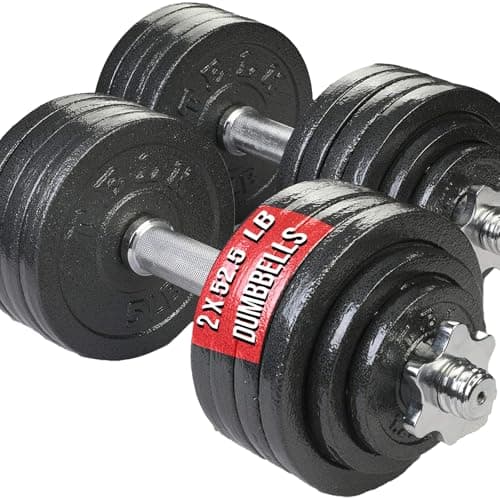
The TELK 105 lb set is the answer to a very specific question: what is the cheapest honest way to own a genuinely useful range of dumbbell weight? It is a plate-loaded pair — two handles, a stack of cast iron plates, and collars to lock them on — that runs from 5 lb up to 52.5 lb in each hand. It skips the one thing that drives the price of a dial dumbbell up, the fast-change mechanism, and puts the savings straight back in your pocket. It is not the slickest set on the market, but per dollar it is one of the most sensible first buys a beginner can make.
This pick replaces the CAP Barbell 52.5 lb pair we previously recommended here, which has been discontinued. The TELK matches the thing that made that set worth buying — a plate-loaded pair reaching 52.5 lb per hand at the lowest price in the category — so the reasoning below is the same reasoning, applied to a set you can actually buy today.
Who it's for
This pair is for the beginner whose first filter is price. You want to start training at home with free weights, you know a single adjustable pair replaces a whole rack of fixed dumbbells, and you would rather put the money you save toward a bench or a bar than toward a dial mechanism. The TELK set reaches the same 52.5 lb ceiling as the flagship dial dumbbells for far less, which makes it the value pick in our adjustable dumbbell roundup.
It also suits the lifter who distrusts moving parts. A dial dumbbell is convenient, but it is also a housing with a selection mechanism inside — one more thing that can eventually fail. The TELK is the opposite philosophy: plates, a handle, and a collar, with nothing electronic in the picture. If you want the simplest route into adjustable weight and you do not mind loading it by hand, this is squarely your kind of tool.
Who should look elsewhere? Anyone whose training lives or dies on speed between sets. If you run drop sets, quick supersets, or circuits where you are constantly changing weight, the manual plate swap will frustrate you, and a dial dumbbell earns its higher price. And if you already know you will push past 52.5 lb quickly — most people do not, but some do — a heavier set like the NÜOBELL 5–80 saves you buying twice.
What you get for the money
The headline is the weight range: 5 to 52.5 lb per dumbbell, 105 lb across the pair. That top end matches the benchmark dial dumbbells, and it is a genuinely useful number. A beginner can press, row, curl, and do most single-dumbbell leg work inside that range for a long time — well past the point where the movements themselves stop being the limiting factor. It is not a token starter weight; it is a real training range you can grow into for months or years.
The second thing you get is a 2.5 lb increment. That sounds like a footnote and is not. Progress on a dumbbell press comes in small steps, and a set that only jumps in 5 or 10 lb chunks forces you to either stall or leap further than you are ready for. Being able to add a single small plate per side is what lets a beginner keep adding weight honestly, week after week, instead of grinding at the same number for a month.
The third thing is the build: cast iron plates with a baked enamel coating, which TELK specifies as resisting rust, chipping and general wear, on 1.15 inch handles. There are no electronics, no dial to jam, and no proprietary selection mechanism — just weight you bolt on and lock down. Combined with the price, the whole thing reads as simple, honest gym equipment rather than a gadget, and that saving is real money in a first gym — enough to put toward an adjustable bench or bank against a future barbell.
How the plate-loaded design works
This is the part to understand before you buy, because it is the whole personality of the tool. The TELK is plate-loaded: each handle accepts a set of plates, and you slide on the weight you want, then lock it with a collar so nothing shifts mid-set. To change weight, you undo the collar, add or remove plates, and lock it again. It is the same principle as a barbell, shrunk down to dumbbell size.
The upside is durability and cost — a mechanism this simple does not wear out. The downside is speed. A manual plate swap is slower than a dial, so if you like to change weight between every set, expect that to add time to a session. In practice, most beginners settle into a few working weights and do not change nearly as often as they imagine, so the swap speed matters less than it seems on paper. But it is a real difference, and it is the single biggest thing separating this pair from a dial dumbbell.
One practical note on sizing: the plates and handles are 1.15 inchesrather than the standard 1 inch, which TELK positions as a stability advantage under heavy lifts. The trade-off is compatibility — if you ever want to add plates later, they have to match that bore rather than being any standard plate off the shelf. Worth knowing up front, though for most beginners the 105 lb in the box is the whole plan for a long while.
Where it falls short
The knocks here are trade-offs, not defects, and they come straight from the low price. The clearest is swap speed: manual plate changes are slower than turning a dial, so a workout heavy on weight changes takes longer than it would with a fast-change set. If your training style is fast and varied, that friction adds up, and it is the main reason to spend up for a dial.
The second is that this set is dumbbells only. TELK's listing is explicit that this version does not include a barbell conversion rod, so if you were picturing clipping the two handles together into a short barbell, that is the other variant of this set and it costs more. Buy the one that matches what you actually plan to do rather than assuming the connector is in the box.
The third is the non-standard 1.15 inch sizingcovered above: good for stability, awkward if you had imagined topping the set up with cheap standard plates down the line. None of these is hidden or unfair — they are the exact price of a simpler, cheaper mechanism, and you know about all three before you buy.
How it compares
The main comparison is against a dial dumbbell. Something like the Bowflex SelectTech 552 reaches the same 52.5 lb but changes weight in a single twist, for a much higher price. That is the whole decision in one line: the TELK saves you money, the dial saves you time. For a budget-first beginner who trains at a steady pace, the TELK is the smarter spend; if you will resent every plate swap, buy the dial and do not look back.
The other comparison is against fixed dumbbells. A single fixed dumbbell is cheaper still, but you would need a dozen pairs to match the range of one TELK set, and that is both more money and far more floor space once you add it all up. This is the case for adjustables in general, which we make in adjustable vs. fixed dumbbells: one adjustable pair replaces a whole rack, and this is the cheapest way to own that pair at a real weight.
Seen that way, the TELK isn't really competing with premium dumbbells at all — it is competing with the temptation to overspend on convenience you may not need, or to cobble together fixed pairs that cost more and clutter the room. As the value entry point to adjustable weight, it is very hard to argue with.
The verdict
The TELK 105 lb set is the honest budget pick in adjustable dumbbells. It reaches a genuinely useful 52.5 lb per hand, moves in sensible 2.5 lb steps, and has nothing electronic to fail — all for a fraction of what a dial set costs. The catch is the manual plate swap, the missing barbell rod, and the non-standard plate sizing, and all three are fair prices for the savings.
Buy it if budget is your deciding factor and you train at a steady pace rather than racing between drop sets. Pair it with an adjustable bench and you have the core of a capable strength setup for a fraction of what the flagship dial units cost. If fast weight changes matter more to you than the savings, the Bowflex 552is the set to read next — but for a value-minded beginner, this is the cheapest route to real dumbbell training, and it does the job.
See how a value dumbbell pair fits alongside a bench, a bar, and a rack — all under one budget — in our $1,000 Build, or compare it against the rest of the field on our best adjustable dumbbells page.