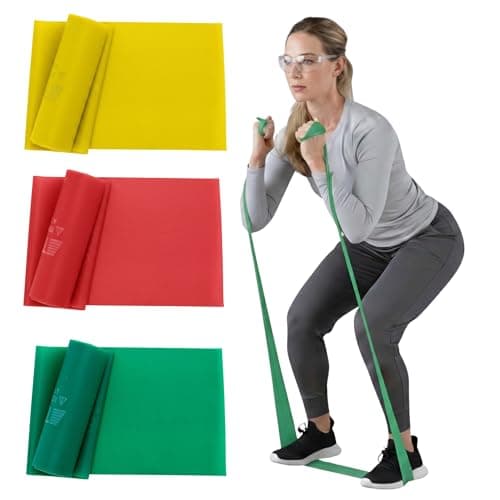
The THERABAND resistance band kit is the least glamorous thing in a home gym and one of the most useful. It is the physio-standard set — the color-coded latex bands you have almost certainly seen in a physical therapist's office — and its whole job is light, controllable resistance for warm-ups, mobility, and rehab. It costs a few dollars, weighs nothing, and lives in a drawer, and it quietly makes every heavier session that follows it safer and better. It will not build your strength, and it is not trying to. It does one narrow job better than anything else.
Who it's for
Honestly? Almost everyone with a home gym should own a set. The clearest case is the beginner who is about to start lifting: a light band is the ideal way to warm up your shoulders, hips, and rotator cuff before you press or pull, and warming up well is one of the simplest ways to train without getting hurt. If you are building a first setup, a THERABAND belongs in the drawer next to the dumbbells, not as a headline purchase but as the cheap insurance that keeps the headline purchases usable.
It is also the right tool for anyone working around a cranky joint or coming back from an injury. Bands let you load a movement gently and control the tension precisely, which is exactly why clinics use them for rehab. If a shoulder or a knee needs careful, progressive work rather than heavy weight, this is the tool that does it. And for travel, a couple of light bands fold into a bag so you can keep a mobility routine going anywhere.
Who should not buy this expecting more than it gives? Anyone hoping to build real strength from bands alone. These are light by design, so they will not stand in for dumbbells on presses, rows, and squats. If you want bands as a genuine strength option — for a no-space setup, say — the heavier tube set is the right call, and we compare the two below and in resistance bands vs. dumbbells.
What you get
The kit is built around color-coded resistance levels — typically the lighter end of the THERABAND range, yellow, red, and green. The color tells you how much tension a band gives, so you pick the one that makes an exercise feel challenging but controlled and move up a color as you get stronger. That simple progression is the whole system: no clips, no anchors, no adjustment, just a flat band and a color code that has been the clinic standard for decades.
The intended uses are warm-up, mobility, and rehab, and the bands are shaped for exactly that. They are long, flat, and light, which makes them perfect for banded shoulder dislocates, face pulls, hip abductions, and the small rotator-cuff work that keeps pressing pain- free. They are not tubes with handles built for heavy pulling — they are strips of latex meant for controlled, higher-rep activation work, and that shape is a feature, not a limitation, for the job they do.
The last thing you get is the THERABAND name, which in this narrow category actually means something. This is the brand physical therapists have trusted for years, so the latex quality and the consistency of the resistance levels are dependable. For a product this cheap, buying the recognized standard rather than an unknown is an easy call — you are paying a few dollars for a tool that clinics rely on daily.
How to actually use it
The highest-value use is the pre-lift warm-up. Before a pressing day, a couple of minutes of banded pull-aparts, dislocates, and face pulls wakes up the shoulders and upper back so the first working set feels solid instead of stiff. Before lower-body work, banded hip openers and lateral walks do the same for the hips and glutes. It is the sort of five-minute habit that pays off for years, and a light band is the perfect tool for it — see where it slots into a session in our beginner home gym workout.
The second use is mobility and rehab. If a joint is tight or recovering, bands let you work through a range of motion under gentle, adjustable load — enough to make the tissue work without overloading it. This is careful, progressive work rather than hard training, and the light resistance is exactly what makes it safe. If you are rehabbing something specific, follow a plan from a professional; the band is just the tool that plan will most often call for.
What owners report
We don't run a test lab, so this reflects the published specs and the pattern of what owners describe. The dominant theme is value: for the price of a coffee or two, buyers get a tool they use before nearly every session, and they consistently call it one of the best-value things in the gym. Nobody expects a light band to be exciting; they expect it to work, last, and cost almost nothing, and that is what it delivers.
The second theme is trust in the brand. Owners who have used bands in physical therapy specifically seek THERABAND out because they know the resistance levels are consistent and the latex holds up. For warm-ups and rehab, that reliability matters more than any feature — you want the band to behave the same way every time, and the clinic-standard set does.
The recurring caveat, when there is one, is simply about expectations: buyers who wanted to build strength find the bands too light, which is not a fault so much as a mismatch. Used for their actual job — warm-up and mobility — owners are overwhelmingly happy. The two who are not are usually the ones who bought light rehab bands hoping to replace weights.
Where it falls short
The honest limits are two, and both come straight from what the tool is. First, the bands are too light to build serious strength. That is by design — they are warm-up and rehab bands — but it means they cannot stand in for dumbbells or a heavier tube set when you want to actually get stronger. Judge them as a strength tool and they will disappoint; judge them as a warm-up tool and they are ideal.
Second, the classic bands are natural latex, so anyone with a latex allergy needs to check for a latex-free version before buying. For most people that is a non-issue, but it is worth flagging if allergies are a concern in your home. Neither limitation is hidden — they are the exact, narrow trade-offs of a light latex band, and knowing them up front means the set will do precisely what you expect.
How it compares
The comparison people most often want is against a heavier band set with handles. Something like the resistance bands with handles stacks to meaningful resistance and adds a door anchor, so it can genuinely train presses, rows, and curls — a real strength option when weights will not fit. The THERABAND does not try to do that. The two are not rivals so much as different tools: buy the tube set for strength, and the THERABAND for the warm-up and mobility work that should come before it.
Against dumbbells, there is no contest for building strength — weights win, and it is not close, which is the whole point of our resistance bands vs. dumbbells guide. But that misreads the role. The THERABAND is not competing with your dumbbells; it is the thing you use for five minutes before you pick them up. In that sense it complements every other piece in the gym rather than competing with any of them.
Seen that way, the THERABAND isn't really up against other equipment at all — it is up against the temptation to skip the warm-up entirely. As the cheapest, simplest way to make that habit stick, it is very hard to beat, and it earns its drawer space in almost any gym.
The verdict
The THERABAND resistance band kit is a small, honest, do-one-thing-well buy. It gives you the clinic-standard tool for warm-ups, mobility, and rehab at a price that barely registers, and it quietly improves every heavier session it precedes. It will not build your strength, and it does not claim to — that job belongs to the weights.
Buy it as the cheap, sensible companion to your real strength gear, keep it in a drawer, and use it for five minutes before you lift. If you want bands that can actually train strength, reach for a tube set with handles instead, or read where each fits in resistance bands vs. dumbbells. But for the job it is built for, the THERABAND is exactly the right tool at exactly the right price.
For the pieces that do the heavy lifting a warm-up band supports, see the whole setup costed out in our $1,000 Build and the priorities in home gym essentials. To put these bands to work, follow how to warm up before lifting, and to pick the right set, read how to choose resistance bands.