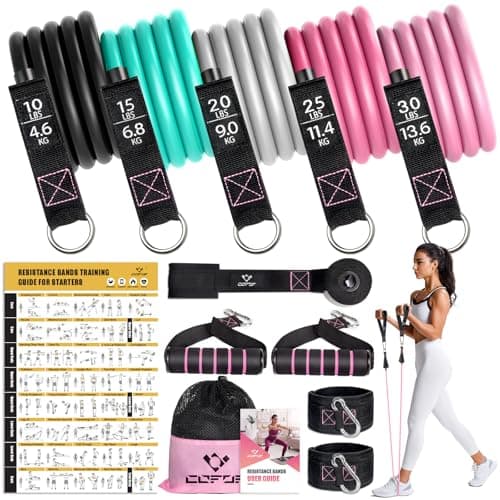
Not every first home gym has room for iron. Some people are working with a studio apartment, a shared room, a strict landlord, or a job that keeps them on the road — and for them the usual advice to “just get some dumbbells” runs straight into the wall of reality. This is the setup a good band set is built for. This 5-level kit is a stackable set of tubes with handles and a door anchor, and the honest pitch is simple: it’s genuine strength work that packs into a drawer. It won’t replace a barbell for someone who has the space and the goals for one, but for the person whose actual choice is bands or nothing, it’s a real answer — and this review is about how much you can get out of it and where its limits sit.
Can you actually build strength with bands?
The instinctive doubt is that bands are for stretching and warm-ups, not for building anything. For a beginner, that’s mostly wrong. Muscle responds to tension and hard effort, and a band that is genuinely difficult to move supplies both. The thing that makes this particular set useful is that it stacks five tubes together: you clip on more tubes as you get stronger, so the resistance climbs with you instead of maxing out in the first week. That progression is the whole game in early training — give a new lifter a way to add difficulty over time and they will get meaningfully stronger, whether the resistance comes from steel or rubber.
Where bands eventually cede ground is at the top end. Once you’re strong enough that even a full stack feels light on your bigger movements, free weights take over as the tool that keeps loading up. But that ceiling is a long way off for someone in their first year, and plenty of beginners never train in a space where the heavier alternative was ever an option. If you want to understand which movements actually build a base and what the minimum gear to train them looks like, our strength training equipment for beginners guide connects the exercises to the equipment, so you can see honestly how far a band set carries you before anything heavier is required.
What the door anchor unlocks
The single feature that turns this from a curiosity into a balanced strength tool is the included door anchor. Handled bands on their own are excellent for the pressing and standing side of training — chest presses, shoulder presses, curls, and extensions, where you stand on the tube or hold it against your body. What they can’t do unassisted is load the pulling half of your training, and that’s exactly the half a typical beginner setup tends to neglect.
The anchor fixes the band at a high, low, or mid point in a closed doorway, and suddenly the whole pulling menu opens up: rows, pulldowns, face pulls, and rotational core work you simply couldn’t load before. That’s a big deal, because a back that pulls as hard as your chest presses is what keeps shoulders healthy and posture upright — the same reason we push beginners toward pull-ups when there’s a bar to hang from. With the anchor doing that job in a doorway, a small set of tubes covers a genuinely complete range of movement, which is why it earns a place in the compact setups we map out in our apartment home gym guide.
Where bands genuinely beat free weights
It’s easy to frame bands as the compromise choice, but there are areas where they win outright, and space is the obvious one. The entire set packs into a drawer — no rack, no shelf, no dedicated corner — which is something no meaningful collection of weights can claim. For a room that has to be a living space the rest of the day, that disappearing footprint is worth more than a slightly better resistance profile you have no room to store.
Portability is the second real edge. Bands weigh almost nothing and go in a suitcase, so your training survives travel, moves, and visits home in a way a set of dumbbells never will. They’re quiet, too — no clanging, no floor impact, nothing to annoy a downstairs neighbor — and they’re forgiving on the joints, since the resistance eases at the exact point in a movement where you’re weakest. Add in a low cost of entry, and they make an unusually smart way to test whether the training habit will stick before you commit money and space to heavier gear. To see how that fits the bigger picture of a first gym, our home gym essentials guide covers the core pieces and where a band set slots in among them.
The honest limits
A fair review has to name the trade-offs, and there are two worth knowing. The first is that the resistance curve differs from free weights. A band gets harder the further you stretch it, so the tension builds toward the end of a rep rather than staying constant the way a dumbbell’s weight does. That’s not worse, exactly — some people prefer it — but it feels different, and it means a “heavy” band set doesn’t translate to an exact pound number the way a dumbbell does. You train by effort and by how many tubes you can move for your reps, not by a figure on the side of the weight.
The second is that tubes wear over time. Rubber under repeated tension ages, especially if it’s nicked, stored in heat or sunlight, or anchored against a sharp edge. Good habits stretch their life a long way — inspect the tubes before heavy sets, keep them out of direct sun, and use the anchor rather than a rough door edge — but you should still plan on replacing them periodically, the way you’d replace running shoes. It’s a small, expected cost rather than a fault, and it’s the fair price of a strength tool that weighs next to nothing and stows in a drawer.
Who it’s for
This band set is for the person whose real constraint is space, noise, or portability rather than budget. If free weights genuinely won’t fit your life — a small or shared apartment, a rented room you can’t modify, a schedule full of travel — bands give you honest strength work that makes no noise and disappears when you’re done. They’re also a low-risk on-ramp for anyone not yet sure the habit will stick: start here, build the routine, and step up to weights later if and when your space and goals grow.
Who should choose weights instead? Anyone with the room and the clear intention to load heavy over time — if a dumbbell or barbell setup fits and you know you’ll want the higher ceiling, that’s the more complete long-term path, and our best home gym equipment for beginners guide lays those picks out in order. But the most important rule in home training is that a tool you actually use beats a better tool you don’t. If the alternative to bands is doing nothing because nothing else fits, bands win every time.
What a full stack lets you train
It’s worth grounding all this in the actual movements, because a band set is only as useful as the exercises it covers. Standing on the tubes turns the handles into overhead presses, curls, and triceps work; pressing the handles out in front of you gives a chest press that loads much like a cable machine. Clip the door anchor high and you have pulldowns; anchor it low and you have rows; set it at chest height for flyes, face pulls, and rotational chops. Loop the tubes under your feet and you can even load squats and deadlifts for the legs. The five stackable tubes are what make that whole list progressable — start with one or two for a given movement, then add more as it gets easy, so the same drawer-sized kit keeps challenging you across presses, rows, curls, and squats long after a single fixed band would have been outgrown. That combination of a full movement list and a way to keep adding difficulty is what separates a real strength tool from a token one.
The verdict
This 5-level resistance band set is the strength option for the setup where weights simply won’t go. It stacks to meaningful resistance so it grows with a beginner rather than topping out early, the door anchor unlocks the pulling exercises a compact setup usually misses, and the whole kit packs into a drawer and travels anywhere. The honest limits are real but manageable: the resistance feels different from free weights, and the tubes are a wear item you’ll refresh over time. Neither undoes the core value for the person it’s meant for.
Buy it if your constraint is space, noise, or portability and you want genuine training that stows out of sight; step up to dumbbells or a barbell when you have the room and the goals for heavier loading. Either way, this is one of the most flexible, lowest-footprint ways to start getting stronger at home. To see how bands sit alongside the other picks and where they fit a full setup, browse our reviews hub and build the room around the space you actually have.