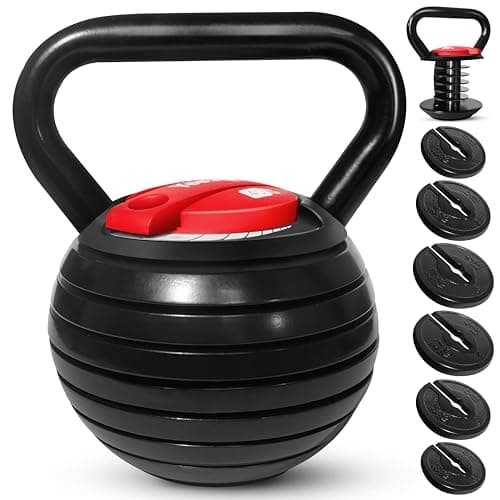
If you’ve decided a kettlebell belongs in your first home gym — and for a lot of beginners it should — the next question is quietly awkward: how many do you actually need to own? Swings, goblet squats, and presses each want a different load, and every one of those numbers climbs as you get stronger. The traditional answer is a shelf of fixed cast bells lined up in increasing sizes, each one covering a narrow band of your training. The Yes4All adjustable kettlebell offers the other answer entirely: one bell that swaps plates to change its weight, so a single unit stands in for several. For an apartment, a shared room, or anyone who simply doesn’t want a stack of iron cluttering a corner, that’s a genuinely useful idea — and this review is about where the trade pays off and where it quietly costs you.
The case for one bell instead of a rack
A fixed kettlebell is a beautifully simple object, but it only ever does one weight. That’s fine on day one, when a single moderate bell covers most of what a beginner can honestly handle. The problem shows up a few weeks in: your swings want more load than your presses, your squats land somewhere in between, and within a couple of months the weight that felt right for everything now feels light for half of it. The classic fix is to keep buying bells — a heavier one for swings, a lighter one for pressing — until a tidy corner turns into a small foundry.
The Yes4All sidesteps that whole progression by replacing several fixed kettlebells with a single adjustable one. Add plates for heavy swings, strip a few off for strict presses, and land in the middle for goblet squats, all from the same bell. Just as importantly, it grows with you: the load you can’t lift today becomes the load you warm up with next season, and you never have to shop for a bigger bell to get there. If you’re still deciding whether a kettlebell or a pair of dumbbells makes the better first versatile weight, our kettlebell vs. dumbbell guide walks through how each one actually gets used, so you buy the tool that matches your training rather than the one that looks good in a photo.
How the weight actually changes
The mechanism is plate-adjustable rather than dial-driven. You open the bell, add or remove the internal plates until you’ve set the load you want, and close it back up. It’s a straightforward, tool-light routine, and after a couple of goes it becomes second nature. What it is not is instant. This is the one place an adjustable bell gives ground to a fixed one: with a shelf of cast kettlebells you simply reach for the next size, whereas here changing weight means a short, deliberate plate swap that takes a moment.
In practice that pause matters far less than it sounds, because of how kettlebell training is usually structured. You don’t nudge the weight up every single set the way you might on a dial dumbbell between drop sets; you pick a load for a block of swings or a round of squats and stay there. So the swap happens between exercises, not mid-flow, and a few seconds of setup at the top of a movement rarely breaks your rhythm. It’s worth knowing the trade exists — if your whole plan is fast, constantly-changing complexes, it’ll nag at you — but for the stop-and-work structure most beginners use, it’s a non-event.
The honest trade-off in the handle
Here’s the part a fair review has to say plainly: an adjustable bell does not feel identical to a solid cast one, and the handle feel is the honest price of the versatility. A one-piece kettlebell has a smooth, continuous handle and a center of gravity that never moves because the whole thing is a single casting. An adjustable bell carries its plates inside a housing, so the grip and the balance don’t feel quite as seamless in the hand. On slow, controlled work — goblet squats, presses, carries — the difference is small and most people stop noticing it quickly. It shows up most on fast, high-rep swings, where a purist can feel that a cast bell whips a touch more cleanly.
None of that makes the Yes4All bad; it makes it a different tool with a different set of priorities. If handle feel is genuinely the thing you care about above all else, that’s a real reason to look at a fixed bell instead — our Amazon Basics kettlebell review covers the simple one-weight cast option, and our fixed vs. adjustable kettlebell guide settles the whole debate in plain English. But for a beginner building strength and conditioning in a small space, that slightly different feel is a fair swap for owning one bell instead of five.
Who it’s for — and who should skip it
The Yes4All is squarely for the space-constrained, grows-with-you buyer. If you live in an apartment, share a room, or just refuse to give up a corner to a row of iron, this bell gives you a full range of loads in a single footprint. It’s also the smart pick when you’re not yet sure how heavy you’ll eventually want to go: rather than guessing at a fixed weight and getting it wrong, you buy once and adjust as your strength catches up. For a first-timer who wants swings, squats, and presses without a shopping spree, it does a lot of jobs from one purchase.
Who should skip it? Anyone who already knows the exact single weight they want, does mostly high-rep ballistic swinging, and prizes a flawless handle above everything else — that person will be happier with a solid cast bell that’s simpler and feels a touch cleaner in flight. And if you’re still assembling the very short list of what to own first, it’s worth seeing where a kettlebell of any kind sits among the core pieces; our best home gym equipment for beginners guide lays out the priorities so a bell earns its spot rather than crowding out something more essential.
Where it fits your space
The strongest argument for this bell is spatial, so it’s worth being concrete about it. A kettlebell is one of the quietest, most floor-friendly ways to train hard at home — no clanging rack, no long barbell, no dedicated platform. Make that bell adjustable and you compress an entire progression of weights into a single object plus a small pile of plates, which is close to the ideal footprint for a room that has to be a living space the rest of the day. You can train in a doorway’s worth of clear floor and tuck the whole thing into a closet when you’re done.
That makes it a natural fit for the kind of setup we map out in our apartment home gym guide, where every piece has to earn its square footage twice over. Pair the bell with a clear patch of floor and maybe a mat, and you’ve got real strength and conditioning work in a space most people assume is too small for a gym. If you’re thinking about the whole picture rather than a single piece, our home gym essentials guide covers the handful of items that, together, turn a corner into a genuinely capable room.
What one bell actually covers
It helps to picture the training this bell is for, because the versatility only matters if it maps to real movements. A kettlebell is at its best on the hip-hinge swing — the ballistic move that builds power and conditioning through the back of the body — and this one lets you load that heavy by stacking plates. Strip a few off and the same bell becomes a goblet squat that’s friendly to beginner knees and hips, or an overhead and floor press for the shoulders. Add loaded carries for grip and core, and a single adjustable unit quietly covers strength, conditioning, and stability work from one corner of the room. That breadth is the real argument: it isn’t one exercise done many ways, it’s many exercises served by a single object that changes weight to suit each of them — which is precisely what a fixed bell can never do without you owning several of it.
The verdict
The Yes4All adjustable kettlebell is the bell for the beginner whose biggest constraint is space, not budget-be-damned handle purity. It replaces several fixed kettlebells with one adjustable unit, it grows with you as you get stronger, and it packs a full range of loads into a footprint an apartment can actually spare. The honest costs are exactly two: the handle and balance feel a little different from a one-piece cast bell, and swapping plates takes a moment rather than being instant. Neither is a dealbreaker for most people — they’re just the fair price of not owning a rack of iron.
Buy it if you’re tight on space, unsure how heavy you’ll want to go, or simply drawn to the idea of one bell doing the work of many. Choose a fixed cast bell instead if you know your weight, love a flawless swing, and have the shelf room to add more later. Either way, a kettlebell is one of the most versatile single purchases a first home gym can make — and if you want to see how it stacks up against the other picks we point beginners toward, our reviews hub lays every option out so you can build the room around the way you actually train.