Here is the honest answer in one line: the iron lasts forever and the mechanism does not. Cast iron plates do not wear out, so an adjustable dumbbell’s lifespan is really the lifespan of the part that holds those plates together - a dial, a set of selector pins, or a threaded collar. With reasonable care, a decent set gives many years of home training. Dropped on concrete twice, the same set can be finished in a month.
That is why this question has a different answer for every buyer. If you want the closest thing to permanent, buy plate-loaded - a steel handle, iron plates and a collar, with essentially nothing to fail. If you want convenience and are willing to set your weights down instead of dropping them, a dial set is the better daily tool and will still outlast several gym memberships.
What actually breaks
Three failure points account for nearly everything, and only one of them is about build quality.
- The selector housing, after a drop. Dial dumbbells carry their mechanism in a shrouded housing, and a hard landing is what cracks it or knocks the indexing out of line. Our own write-up of the dial benchmark lists exactly this: the plastic dial housing needs to be treated with some care.
- Partial engagement. Changing weight while the dumbbell is not fully seated in its cradle, then lifting, loads parts that were never designed to carry it. This is the quiet killer, and it is entirely avoidable.
- Collars and fasteners working loose. On plate-loaded and quick-lock sets, the mechanism does not break so much as drift - a collar that is a quarter turn loose rattles, wears and eventually lets a plate shift mid-set.
Notice what is not on that list: the iron, the handle and the weight range. Those do not degrade. Which means the real question when you are shopping is not “how long will this last” but “how many things are in here that can go wrong, and how careless am I willing to be?”
What to look for if durability is the priority
Fewer moving parts. A plate-loaded handle has one adjustment part - the collar. A dial set has a mechanism per dumbbell. Neither is wrong; one simply has fewer ways to fail.
Metal where the load lives. A metal handle and a metal selector feel different from a plastic shroud over the same job, and they age differently too. This is the clearest distinction at the premium end of the dial category.
Finish that resists rust. Baked enamel on cast iron and vinyl coatings both hold up in a garage; bare machined steel wants wiping and the occasional light oil. If the room is damp, this matters as much as the mechanism - see preventing rust on gym equipment.
Standard parts. If the handles and plates use a non-standard diameter, future add-ons have to match. Our value pick publishes 1.15 inch handles and plates rather than the standard 1 inch, which is worth knowing before you plan an upgrade path.
What we would buy for longevity - live prices, last verified October 5, 2026
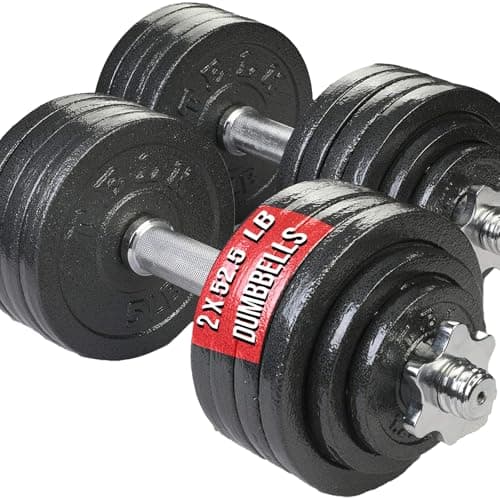
TELK 105 lb Adjustable Dumbbell Set (52.5 lb each)
A plate-loaded cast-iron pair that runs from 5 to 52.5 lb per hand in 2.5 lb steps — the cheapest route to a 52.5 lb ceiling in this roundup.
#ad · Price as of October 5, 2026 · Affiliate disclosure
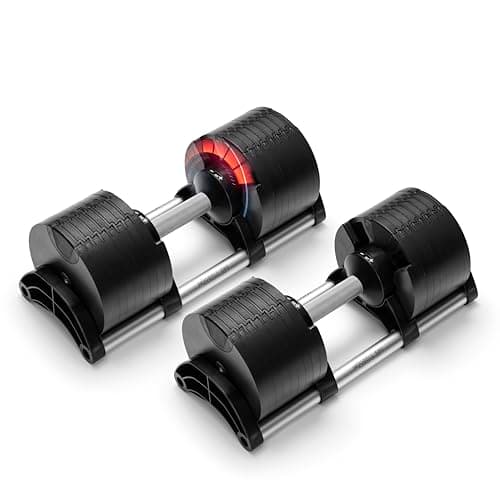
NÜOBELL 5–80 lb
A premium, metal-handled dial dumbbell that goes to 80 lb — the pick once you outgrow a 50 lb ceiling.
#ad · Price as of October 5, 2026 · Affiliate disclosure
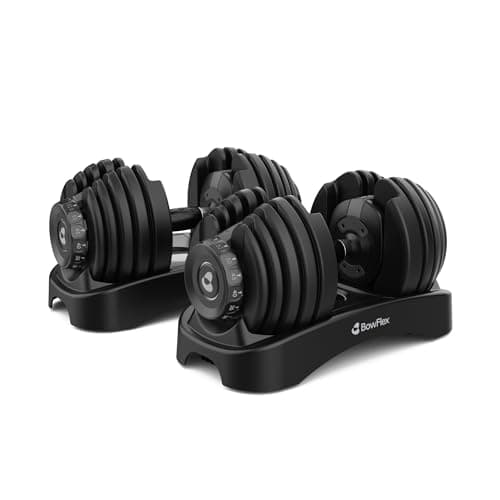
Bowflex SelectTech 552
The dial-adjust benchmark: one dumbbell replaces 15, from 5 to 52.5 lb, in a footprint the size of a shoebox.
#ad · Price as of October 5, 2026 · Affiliate disclosure
Mechanism against mechanism
We have not run a decade of reps through any of these, and we will not pretend to have a failure-rate number for you - nobody who has not run a long-term test honestly has one. What the table does show is where the risk sits in each design, which is the part you can actually act on.
Five habits that decide the answer
1. Set them down, never drop them. This single habit is most of the lifespan. Finish the set, lower the dumbbells to your thighs, then place them on the floor or back in the cradle.
2. Fully seat before you adjust. Return the dumbbell completely into its cradle before turning the dial, every time.
3. Check engagement before you lift. Lift an inch, feel for anything loose, then press. Two seconds, every weight change.
4. Keep them off damp concrete. A stand, a shelf or a rubber mat is enough - see how to store home gym equipment.
5. Re-check collars and screws quarterly. Ten minutes with an Allen key is the whole maintenance routine, and it is in maintaining home gym equipment.
The verdict
Adjustable dumbbells are not fragile, they are drop-sensitive - and that is a habit problem rather than a product problem. Expect the cast iron to outlive you and the mechanism to last many years of home training if you set the weights down, seat them fully before adjusting, and keep them dry. If you know you will be careless, or you train hard enough that weights occasionally hit the floor, buy plate-loaded and accept slower changes, or read adjustable vs. fixed dumbbells and buy fixed. Everything above comes from the manufacturers’ own listings plus our read of where each design concentrates risk; prices in the picks are live and were last verified October 5, 2026.