The short answer: a Smith machine is good for a home gym in one specific case - you train alone, you want to press and squat heavy, and you would rather the bar ran on rails than spend a year learning to stabilise it. In that case it is genuinely excellent, and the catch hooks every few inches mean a failed rep is a twist of the wrists rather than a 911 call.
For the buyer this site is built for - a first home gym around $1,000 - the answer is almost always no, and not because the machine is bad. A bench, a pair of adjustable dumbbells and a stand with safety arms cover more training, in less space, for a fraction of the money. The Smith machine is a third or fourth purchase masquerading as a first one.
What the fixed bar path actually changes
A Smith bar is captured in rails, so it travels one line and cannot tip, drift or fall sideways. Three consequences follow, and they are the whole argument in both directions.
- You can fail safely, alone. Rotate the bar into the nearest hook and it stops. That is the single best reason to own one in a house where nobody is home when you train - see training without a spotter for the free-weight version of the same problem.
- The learning curve nearly vanishes. Nothing to balance means a beginner can load a press or a squat pattern in week one instead of month three. For someone returning to lifting after a long break, that is a real feature.
- The stabilising work disappears too. Balancing a free bar is part of what a barbell lift trains. On rails that part is gone, which is why a Smith squat does not transfer one-for-one to a free squat. Free weights vs. machines is the long form of this trade.
There is one more mechanical detail worth knowing before you buy: many Smith machines run their rails on an angle rather than vertically, to approximate a natural press path. Angled and vertical both work; they simply feel different, and the listing will say which it is.
What it costs you beyond the price
Read the space rows carefully, because they are where home Smith purchases go wrong. The frame is tall by design - the rails run most of its height - so a basement or a garage with a door track overhead can rule it out before any training argument matters. Measure to the lowest obstruction, then check the published assembled height on the listing; our low-ceiling equipment page covers what to buy when the room says no.
The cheap route: an attachment, if your rack takes one
If you already own a power cage, you may not need a Smith machine at all - you may need rails and a carriage bolted to the cage you own. That route costs a fraction of a complete machine because you are not buying a second frame.
The condition is fit, and it is strict. Attachments are built for specific upright dimensions - 3 x 3 inch tubing, or one brand’s hole pattern and upright height - and a near-miss is a return, not a drilling project. Measure your uprights, count your hole spacing, and read the compatibility line on the listing twice. Our Smith machine roundup separates complete machines from attachments for exactly this reason.
Who should buy one, in order
What we would buy, by situation - live prices, last verified October 21, 2026
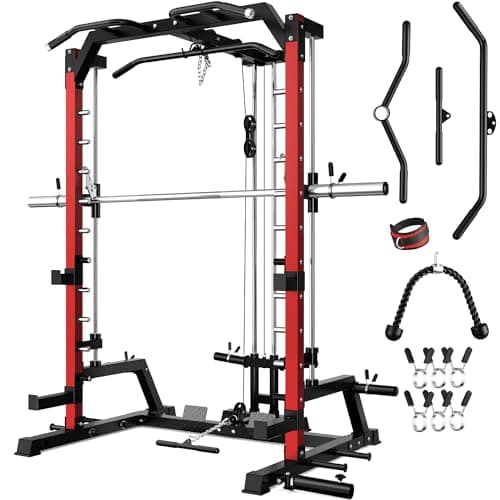
JELENS SR01 Smith Machine
The cheapest complete Smith machine from a brand that publishes its numbers - a guided bar, a lat tower and a landmine in a 16 sq ft half-frame.
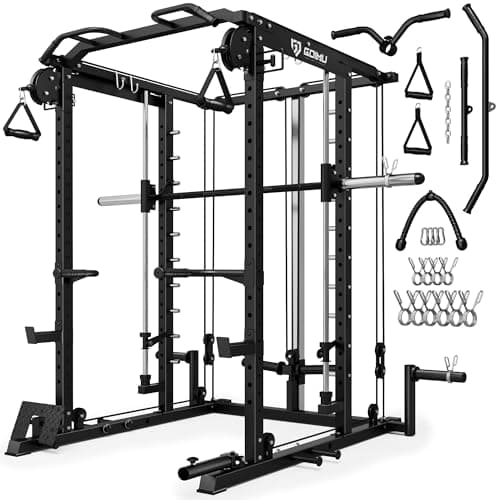
Goimu S1-V4 Smith Machine
A Smith bar, a full power cage and a cable crossover in one frame, with the carriage rated to 1,000 lb on linear bearings and a 2-year warranty behind it.
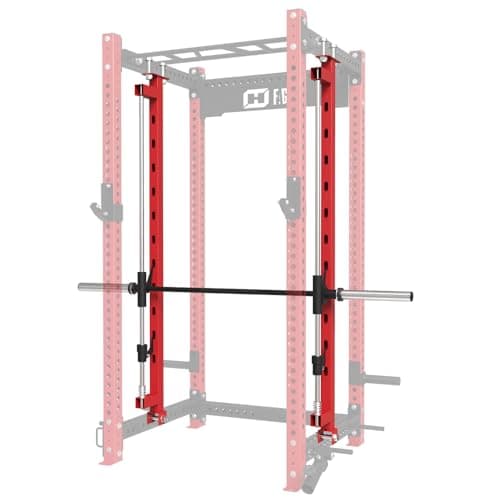
FAGUS H Smith Machine Attachment (3 x 3 in Rack)
The cheap way to add a guided bar if you already own a 3 x 3 in power cage - an 800 lb Smith bar on chrome guide poles with eleven safety positions.
#ad · Price as of October 21, 2026 · Affiliate disclosure
Note the order. A complete machine only makes sense if you do not already own a rack; if you do, the attachment is the sane purchase. And if you own neither and your budget is finite, buy the rack first - it does more, for less, in less space.
When the answer is no
Four situations where we would tell you not to buy one:
- It is your first purchase. Start with a bench and a load. Our $1,000 build sequences the whole gym, and a Smith machine is not in it.
- Your ceiling is low. A tall fixed frame in a short room is money spent on a rack you cannot use properly.
- You want to get good at barbell lifting. Rails remove the skill you are trying to build. Buy a rack with safeties and learn the lift - squat stand vs. power rack sizes that purchase.
- You mostly want machine-style training. If pins and stacks are the appeal rather than a guided bar, an all-in-one weight-stack machine gives you more exercises for the same money - best home gym machines ranks five, and weight machines vs. free weights settles that choice.
If none of those four apply and the guided path is what you want, buy it without guilt. A Smith machine in a garage is a lot of training for a lifter who would otherwise press cautiously, alone, well inside what they are capable of.