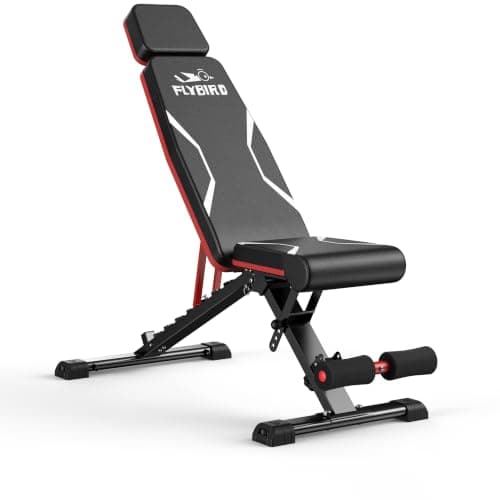
The FLYBIRD WB3 is the bench you reach for when you’re tall. Nearly every budget bench is built around an average-height lifter, and if you’re over about six foot you find out the hard way — your head hangs off the top of the pad the moment you lie back to press. The WB3 answers that directly with a 33 to 35 inch extended backrest and a detachable adjustable headrest, sized for lifters up to 6 ft 5 in. It’s rated to 750 lb, and despite the longer frame it still weighs 27 lb and folds away when you’re done.
Who it’s for
The WB3 is for the lifter who’s been let down by bench length. If you’ve pressed on a budget bench and felt your head drop off the end, or your hips run out of pad on an incline, that is the specific problem this bench was designed around. The extended backrest keeps you supported from shoulders to hips, and the headrest clips on when you want it and comes off when you don’t. A 17.5 inch seat height keeps your feet planted whether you’re tall or average.
It suits a broad training plan, too. With 8 back, 4 seat, and 3 leg positions — 90 combinations in total — it covers flat, incline, and decline pressing, rows, shoulder work, and step-ups, with dumbbells or a barbell inside its rating. Pair it with a set of adjustable dumbbells and you have a complete upper-body gym. If you’re still deciding whether a plain flat bench or an adjustable one fits your plan, our guide on flat vs. adjustable benches lays out the trade-offs in plain English.
A quick reality check on who should look elsewhere. If you’re average height and the headrest holds no appeal, you’re paying for length you won’t use — and the WB5 gives you an independent ASTM certification to 800 lb that the WB3 doesn’t carry, plus a flat-to-upright range. If your room is genuinely tiny, note that the WB3’s assembled footprint is longer than a standard bench, because the extended backrest and 18 inch base legs are the whole point. The WB3 rewards height and head support; it isn’t trying to be the smallest bench in the line.
The specs that matter
Three numbers on the WB3’s spec sheet do the real work. The first is the 33 to 35 inch extended backrest with its detachable headrest. Bench length is the spec nobody checks until it bites them, and on a standard budget bench a taller lifter ends a set of incline presses with their head unsupported. FLYBIRD publishes a fit of up to 6 ft 5 in for this frame, which is the number to weigh it on.
The second is the 750 lb rating. FLYBIRD gets there with a five-times-reinforced triangular frame, 18 inch extended base legs, and dual rectangular support bars — the wider stance is what keeps a longer bench from feeling tippy under load. Treat that figure as a ceiling rather than a target and it covers your body weight plus a beginner’s barbell with plenty in hand. Worth knowing: it’s a manufacturer rating, not an independently certified one like the ASTM 800 lb on the WB5.
The third is the position count — 8 back, 4 seat, and 3 leg settings, which FLYBIRD counts as 90 combinations. Flatten it for presses and rows, tilt it up for incline and shoulder pressing, drop it for decline work. And for all that length, it still folds to roughly 7.5 by 11.3 by 33 inches at 27 lb, so it goes behind a door or under a bed when you’re finished. Our apartment home gym guide covers the rest of a setup that packs down that way.
What owners report
We don’t test equipment in a lab, so what follows is drawn from the published specs and the pattern of what long-term owners describe — not our own bench numbers. The most consistent theme is fit. People who chose the WB3 tend to have chosen it because they’re tall, and they report that the extra backrest length and the headrest do exactly what they were bought to do: no more finishing a set with your head off the end of the pad.
The second recurring note is stability for the size. A longer bench could easily feel wobbly, and the extended base legs are the reason it doesn’t. FLYBIRD is a familiar name in budget benches, and that track record shows up here as a frame that does what it says without drama. If you want to see where it sits against the rest of the field, our best adjustable weight benches roundup ranks it with live prices.
The third thing worth flagging is the trade that comes with the length: the assembled footprint is bigger than a standard bench, so it wants a little more clear floor when it’s set up. It still folds down small, but if your constraint is the space the bench occupies mid-session rather than mid-week, that’s the honest thing to be clear-eyed about before you buy.
Where it falls short
The honest knocks are about certification and footprint, not sloppiness. The clearest one is that its 750 lb figure is a manufacturer rating, and it sits below both the WB5 and the WB7. More to the point, the WB5’s 800 lb is ASTM-certified — checked against an independent standard rather than stated by the brand. That certification is rare at this price and it’s a real reason to prefer the WB5 if third-party assurance matters more to you than bench length.
The related point is footprint. Everything that makes the WB3 work for a tall lifter — the longer backrest, the 18 inch base legs — also makes it take up more floor when it’s set up. It folds down as small as any bench in the line, so storage isn’t the issue; it’s the space it needs while you’re actually training. In a very tight room that’s worth measuring before you order.
Neither of these is a flaw so much as a boundary. The WB3 is a specialist: it solves the tall-lifter problem better than anything else at this price and doesn’t pretend to be the do-it-all pick. The mistake would be buying it on price alone when you’re average height and would be better served by the certified capacity of the WB5. Buy it for the job it names, and it won’t disappoint you.
How it compares
The natural comparison is across the FLYBIRD line to the WB5, the brand’s default budget flat-incline-decline bench. The WB5 is ASTM-certified to 800 lb, adjusts flat to upright, and folds flat — a do-it-all bench built around an average-height lifter. If you want more capacity still, the WB7 jumps to a 1,300 lb rating and a wider, commercial-style frame for loading hard. We put the two heavier siblings head to head in FLYBIRD WB5 vs WB7 if you’re weighing the step-ups.
The trade is clean, which makes the decision easy. Move up the line and you gain rated capacity and independent certification; come across to the WB3 and you gain backrest length, a headrest, and a fit for a taller frame. There’s no “better” bench here, only the right match for how and where you’ll train. Choose the WB3 when height and head support are the priorities; choose the WB5 when certified capacity is. If you’d rather see the whole category before you commit, our bench roundup stacks every pick side by side.
It’s worth remembering that a bench is only half of an upper-body gym. Whichever FLYBIRD you land on, it earns its keep paired with a solid pair of dumbbells — the bench provides the angles, the dumbbells provide the load, and together they cover pressing, rowing, and shoulder work in a corner. If you’re assembling the whole kit rather than one piece, our home gym essentials guide covers the short list of what to own first, and the WB3 is a tidy way to check the bench off that list.
The verdict
The FLYBIRD WB3 is the adjustable bench for the lifter who’s taller than the bench market assumes. The extended backrest and detachable headrest solve a real, specific problem, the 750 lb rating covers a beginner’s loads with room to spare, and 90 position combinations cover flat, incline, and decline. Judged as what it is — a tall-lifter bench that still folds away — it does its job cleanly.
The only real decision is whether you need the length. If you’re around six foot or over, or you want a headrest under you when you press, the WB3 is the smart pick and there isn’t much competition at the price. If you’re average height, the WB5 and its independent ASTM 800 lb certification are the better default. See how a bench fits alongside the rest of a first setup in our $1,000 Build, and pair it with the right dumbbells from our adjustable dumbbells roundup to turn a corner into a capable upper-body gym.
Think of the WB3 as the bench that fits you first. If every budget bench you’ve tried has left your head hanging off the end, that’s the feature that matters most — and it’s the one the WB3 is built around. Match it to your height, and it’s hard to fault for the money.