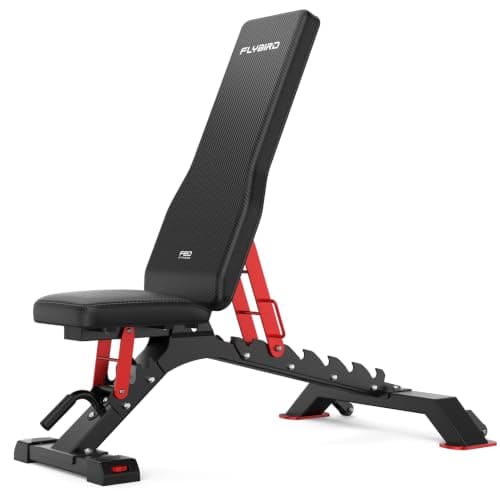
Who it’s for
The FLYBIRD WB7 is for the beginner who already knows a barbell is in the plan. It is FLYBIRD’s heavy-duty model, and the whole reason it exists is to give you a bench you can load hard without second-guessing it. If your setup is built around adjustable dumbbellsand light pressing, this is more bench than you need — the lighter WB5 will serve you better and store smaller. But if you own or are buying a barbell and a set of plates, and you fully intend to push your bench press, overhead press, and rows up over the coming year, the WB7 is the one that keeps up. Think of it as buying ahead of your strength rather than up to it: the bench that still feels solid two years from now when the loaded bar is a lot heavier than it is today. It fits naturally into a barbell- focused $1,000 build, sitting under a bar inside a rack, and it is aimed squarely at the person who would rather buy once than upgrade later. If that describes you, the extra frame is not overkill — it is the point.
A word on the barbell itself, since that is the whole reason to choose this bench: pressing a loaded bar safely at home means pairing the WB7 with a squat stand or power rackand setting the safety arms every single time. The bench gives you a stable surface; the rack gives the bar somewhere to land if a rep fails. Buy them as a pair rather than one and then the other — the complete setup is what makes heavy solo pressing sensible in the first place, and it is why a serious bench like this belongs next to a serious rack, not on its own in the middle of the floor.
The specs that matter
The number that sells this bench is the 1,300 lb rating. That is the combined total of your bodyweight plus whatever is on the bar, and it is a very high figure for a folding bench — far past anything a beginner will ever load. One honest note: this is a manufacturer rating, not the independent ASTM certification that the WB5 carries, so treat it as a strong signal of intent rather than a lab-verified stamp. Backing that number up is a wider, commercial-style frame, which is the spec that actually matters when you are pressing heavy: a broader, more planted base means less wobble and more confidence at the bottom of a rep. And despite all that, the spec sheet still lists it as foldable, so the heavy-duty build does not force a permanent footprint on a spare room. For a beginner, the takeaway is simple — you are paying for stability and headroom, the two things that make barbell pressing at home feel safe. If you are still deciding between an adjustable bench like this and a plainer fixed one, our flat vs adjustable bench guide lays out the choice.
The “wider frame” on the spec sheet is worth translating into plain terms. A broader base spreads the load across more floor, which is what keeps the bench from tipping or rocking as you drive a heavy rep — taller and heavier lifters tend to feel that difference most. The cost is floor space: this is not a bench you tuck behind a door. It wants a dedicated corner, ideally on a rubber mat that protects the floor and cuts the noise, which is a good reason to plan your layout before it arrives rather than after. Measure the space first, and the bench will feel like it belongs there instead of crowding the room.
What owners report
Owners keep coming back to two things: the weight rating for the money and how stable it feels under a heavy barbell. People who moved up from a thinner budget bench describe the WB7 as reassuringly solid — the kind of bench that does not creak, shift, or make you think about the equipment while you are pushing a hard set. The wider frame gets specific praise from taller and heavier lifters, who tend to feel more balanced on it than on a narrow folding bench. Owners also note, with some surprise, that it still folds for storage despite the beefier build, which matters if the bench has to share a garage with a car. On the flip side, the same people are upfront that it is heavier and bulkier to movethan a light bench — the trade you make for that stability. As always, this is not us testing the bench; we do not own it or press on it. It is the consistent pattern in what buyers report, checked against what the spec sheet lists, and for a heavy-duty bench the two agree.
Because it is a heavier bench, it is worth thinking about where it will live before you buy. Owners who keep it in a shared garage often leave it set up in a corner rather than folding it after every session, simply because it is more to lift than a light bench. That is perfectly fine — it does not need to be folded away to be out of the way — but it is a real consideration if your training space doubles as somewhere you park a car or store other things. A bench you use is worth far more than a bench you keep perfectly tidy, so set it up where you will actually train.
Where it falls short
The WB7’s weaknesses are the flip side of its strengths. Because it is built to be planted and strong, it is heavier and bulkier than the WB5— you will feel that both when you carry it and when you fold it away, and it will not disappear into a closet quite as neatly. The bigger caveat is fit: for a light-dumbbell beginner, this is more bench than you need. If you are not loading a barbell, the extra capacity and frame are weight and cost you are not using, and that budget might do more elsewhere in your gym. The other thing to be clear-eyed about is the rating itself — 1,300 lb is a manufacturer figure rather than an ASTM certification, so if an independently verified number is what reassures you, the WB5 is the bench that carries it. None of these are dealbreakers for the right buyer; they are simply the reasons the WB7 is a specific tool for a specific job rather than the default first bench.
None of this should scare off the right buyer, though. The extra weight and footprint are just the physical form of the stability you are paying for — you cannot have a bench that feels planted under a heavy bar and also vanishes into nothing when you are done. The honest trick is to know which of those two things you value more before you order: rock-solid under load, or light and tuck-away small. If it is the former, the WB7 is doing its job exactly as designed.
How it compares
Lined up in our best adjustable benches roundup, the WB7 is the heavy-duty specialist. Its closest sibling is the FLYBIRD WB5: same brand, but the WB5 is lighter, ASTM-certified to 800 lb, cheaper, and easier to store — the bench most beginners should buy. The WB7 trades that easy portability for a much higher rating and a wider frame, which only pays off if you are loading a barbell hard. The other natural comparison is the REP Nighthawk, a pricier step-up from a dedicated strength brand with a wider pad and a finer set of angles. Against the REP, the WB7’s pitch is more raw capacity and a wider base for less money, at the cost of the wider pad and the finer FID angle range. In short: pick the WB5 to start, the WB7 to press heavy on a budget, and the REP if a plusher pad and a strength-brand pedigree matter more to you than a big rating.
If you want the short version of all that: the WB7 is the pick when “can I load this as heavy as I want for years?” matters more than “how small does it fold?” For a barbell-first beginner who plans to get properly strong, that is usually the right priority — and it is why this bench, rather than a lighter one, is the honest recommendation for that specific person. Anyone still mostly lifting dumbbells should save the difference and start with the WB5.
The verdict
The FLYBIRD WB7 is the bench you buy when the plan is to load a barbell and keep adding weight. Its high rating and wider frame give you stability and headroom that most folding benches do not, and the fact that it still folds for storage means you get that without surrendering a permanent corner of the room. It is not the bench for a tentative, dumbbell-only start — that is the WB5 — and it is not chasing the wider pad of the REP Nighthawk. What it does is one thing very well: give a barbell-minded beginner a bench that feels planted under a heavy bar. If that is the gym you are building, the WB7 belongs in it; see how the whole thing comes together in our $1,000 build, then come back and buy the bench that is built to keep up with your bar.