Who it’s for
The REP Nighthawk is the bench for the beginner who has stopped asking “will I actually stick with this?” and started asking “which bench do I keep for years?” It is a flat-incline-decline (FID) bench from REP Fitness, a dedicated strength-equipment brand rather than a generic online seller, and the whole point of it is longevity. If you already own a barbell or a solid pair of adjustable dumbbells, and pressing is going to be a fixed part of your week, this is the bench that repays the commitment. Think of it as the difference between furniture you replace and furniture you keep. It is not the cheapest way to get started — if you are still testing whether a home gym fits your life, buy something lighter first and revisit this one later. But for someone furnishing a setup they plan to grow into, the Nighthawk buys years of confidence instead of a season of “good enough.” The people it suits are past the trial phase: they train several times a week, they load real weight, and they are tired of a bench that shifts under them. If that is you, it slots into a full $1,000 buildas the bench you never think about replacing — though at this price it will take most of your bench budget, so read the trade-offs below before you commit.
One more group this bench quietly suits: people who bought a cheap bench first, found the small wobble annoying, and now want the last bench they will ever need to buy. There is no shame in staging the purchase that way — a budget bench is a perfectly good place to start — but if you already know you are past that point, skipping straight to a bench like this saves you buying twice. If you are mapping out the order of your purchases, our what to buy first guide helps you slot the bench into a sensible sequence alongside the rack, bar, and plates rather than buying everything blind on day one.
The specs that matter
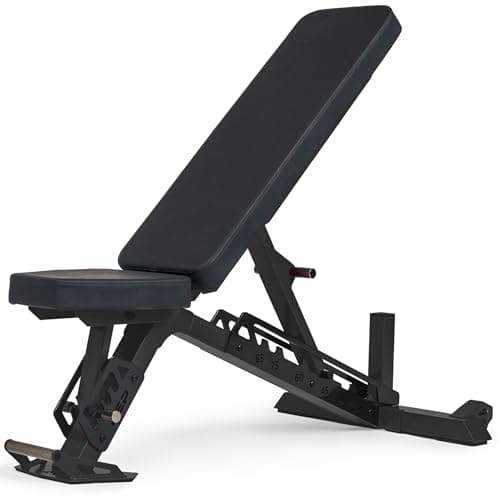
The headline on the spec sheet is the range of angles: seven back positions — 0, 15, 30, 45, 60, 75 and 85 degrees — and four seat positions of -15, 0, 10 and 20 degrees. Flat covers the bench press and dumbbell rows, the incline steps hit the upper chest and shoulders in finer increments than a budget bench offers, and that -15 degree decline seat opens up lower-chest presses and decline sit-ups. The second number that matters is the frame: REP builds the Nighthawk from 7- and 14-gauge steel and rates it to 700 lb, with the pad set at a 16.7 in height — the standard competition bench height, which is a genuinely useful detail if you ever want your home pressing to match how you would lift on a platform. It stores upright, so the extra sturdiness does not cost you a permanent footprint in a spare room or garage. For a beginner, the specs that matter are rarely the flashy ones; they are the ones you feel every session — a bench that does not wobble and a pad that does not sag. If you are still weighing this adjustable style against a simpler fixed bench, our flat vs adjustable bench guide walks through which jobs each shape does best.
A quiet practical point that budget benches rarely earn: a good FID bench proves its worth in how it works inside a rack. Because the frame is stable and the pad sits at a sensible height, sliding it into a squat stand or power rackfor barbell pressing is straightforward, and the safety arms do the job of catching the bar — you never press a loaded barbell over a bench alone. For a beginner training solo, that pairing of a solid bench and a rack with safeties is the single biggest safety upgrade you can make at home, and a bench that stays put makes the whole setup feel calmer to use.
What it does well
We do not test gear, so everything here traces back to the published spec sheet rather than a lab session — and on this bench the spec sheet does the arguing. The heavier steel is the difference you would feel first: 7- and 14-gauge tubing is a different class of material from the thin-wall frames used on sub-$100 benches, and it is why REP can put a 700 lb number on a bench that weighs 88 lb rather than 30. The wider back pad REP fits here is the second: pad width is what makes you feel planted through the shoulder blades on a press, and a narrow budget pad is the most common reason a cheap bench feels tippy. The closed ladder adjustmentis the third — you change the back angle by lifting and dropping the pad into a ladder of thick steel rungs, which is faster and more positive to set than a pop-pin, and REP quotes the same seven angles every time rather than a vague range. Add the upright storage and you have the combination this price buys: a bench heavy enough to stay still and light enough to stand in a corner.
Where it falls short
The honest trade-offs are about money and numbers, not quality. The first is price: the Nighthawk runs roughly three times what our budget bench pick costs, so if you are not yet sure you will train consistently, it is a lot of bench to commit to on day one. For the price of the REP alone you could cover a cheaper bench plus another piece of your setup, which is worth weighing if your budget is fixed — and on a site about building a gym for under $1,000, that is not a small point. The second is the 700 lb rating, which is genuinely lower than benches costing a third as much: the FLYBIRD WB5 is ASTM-certified to 800 lb and the WB7 is rated to 1,300 lb. Seven hundred pounds is far beyond what any beginner will ever put on a bench, so this is a spec-sheet loss rather than a practical one — but if you shop on the headline number, the REP loses that contest and you should know it. The third is simply that it can be overkill for a very first, tentative setup— a nervous beginner working with light dumbbells does not need this much bench yet, and that money might do more spread across other gear in a sensible what-to-buy-first plan. There is nothing wrong with the bench itself; these are reasons it might be the wrong bench for a particular moment.
It also helps to frame the cost over time rather than on day one. A bench you keep for years works out cheaper per session than a budget bench you replace after eighteen months, and well-built strength gear tends to hold its value if you ever pass it on. That does not make the sticker price small, but it does change the math for a committed lifter — you are buying fewer benches across your training life, not just one expensive one now. If money is genuinely tight this month, that is a reason to start cheaper, not a reason to think the REP is poor value.
How it compares
Against the field in our best adjustable benches roundup, the Nighthawk is the deliberate step-up pick, and it is easiest to understand next to its neighbors. The FLYBIRD WB5is the value default — ASTM-certified to 800 lb and about a third of the price — and it is honestly the smarter buy if you are not yet certain you will stick with training. If your priority is loading a barbell as heavy as you can, the FLYBIRD WB7pushes a much higher rated capacity and a wider, commercial-style frame for considerably less than the REP, trading the brand pedigree and the finer angle range for raw numbers. Where the Nighthawk wins is the combination the others do not match at once: seven back angles plus a decline seat, heavier-gauge steel, a competition-height pad, and a genuine strength brand standing behind it. You pay a lot for that combination, and whether it is worth the premium comes down to one question — how sure are you that this is the bench you keep? If the answer is “very,” the REP is a defensible call; if you hesitate, one of the FLYBIRDs will serve you well for far less.
The verdict
The REP Nighthawk is the bench to buy when you already know home training is part of your life. It is not the one we hand a first-week beginner — that is the WB5 — and it is not the capacity-per-dollar play either, which is the WB7. It is the one we’d point you toward the moment you are furnishing a gym you intend to keep for years and you would rather buy once. You are paying for heavier steel, a wider pad, a finer set of angles, and the reassurance of a real strength brand; for a committed lifter that is money spent in the right place, and for everyone else it is more bench than the moment calls for. If you want to see exactly where it sits next to the cheaper and the heavier-duty options before you decide, start with our bench roundup, then come back here when you are ready to commit to the one you keep.