Measure the idle footprint, not the training footprint
Every piece of gym equipment needs room to use. That is not what kills a small-room purchase - you can always move a coffee table for 45 minutes. What kills it is the floor the machine claims for the other 23 hours of the day, in a room that is also a bedroom, a nursery or an office.
So rank cables the way you would rank furniture: what does it occupy when nobody is training? A rack pulley occupies nothing, because it hangs off something you already own. A wall station occupies nothing on the floor, because it is bolted to a wall. A folding tower occupies the 2.92 sq ft it folds down to. A freestanding station occupies its full base, permanently.
That table is the whole page. Read down the second column and buy the first row you can satisfy in the third. The one real trap is the wall station: it is the best space-efficiency on the list and the only pick that puts permanent holes in someone else’s property, which makes it the wrong answer for most renters - wall-mounted vs. freestanding applies the same logic to racks.
What you give up to go small
Compact cable setups make three concessions, and they are worth knowing before the box arrives rather than after.
- Weight changes are manual. A plate-loaded pulley or tower means sliding plates onto a pin, not moving a pin in a stack. It is slower, it is noisier, and it means you need plates - if you do not own any, add that to the price. Our how to choose weight plates guide covers what to buy.
- Single cable path on most of them. Crossovers and simultaneous high-low work need two independent pulleys, which on this list is the wall station only. Everything else does one line of pull at a time.
- Lower ratings than a commercial stack. 280 to 400 lb covers every pulldown, pushdown, row and fly a home lifter will do for years - but it is not a 200 lb selectorized stack with a 4:1 cable ratio, and the published figure is a total load-bearing rating rather than a promise about the resistance you will feel.
None of those matter much for the job most people buy a cable for. If they do matter - if you want crossovers and a stack and quick changes - then you want a real machine in a real corner, and our cable machines roundup ranks six including a 2-stack wall station and a full crossover.
The rack pulley is the value answer, and it has one condition
For about a tenth of what a frame costs, a rack-mounted pulley gives you lat pulldowns, straight-arm pulldowns, tricep pushdowns, face pulls and cable rows. It is the best value purchase in this entire category and we say so on every page where it comes up.
The condition is in the name: it needs something to hang from. A power rack, a squat stand with a pull-up bar, a doorway bar rated for it, or an exposed joist or beam. If you do not own one of those, the cheap option is not cheap any more - you are buying a rack too, and at that point a folding tower or a wall station is the smaller and simpler purchase. See racks and stands if a rack was on the list anyway.
Who each pick is for
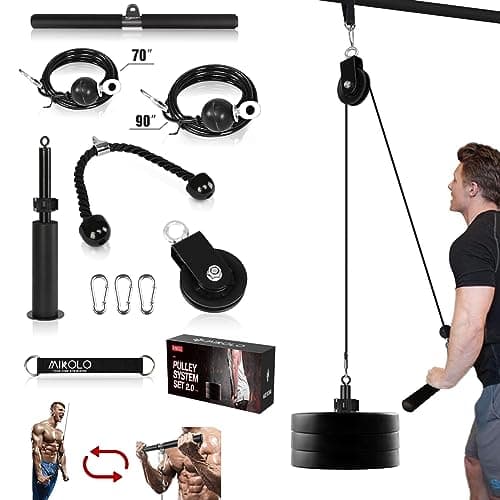
- Mikolo LAT and Lift Pulley System - you own a rack or a beam. Zero idle footprint, 280 lb rated, two cable lengths, under 7 lb. Nothing else here competes on value.
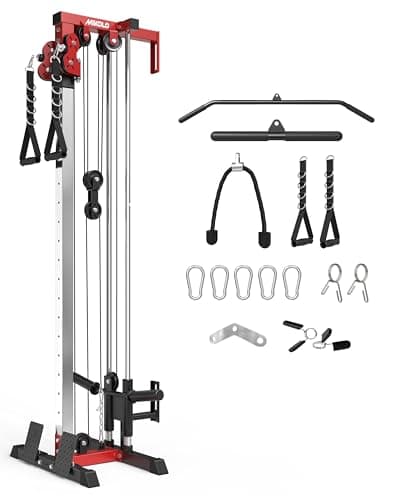
- Mikolo Wall Mount Cable Station - you own the wall. Dual adjustable pulleys across 19 heights, 400 lb rated, no floor used, and the only pick that does true crossovers.
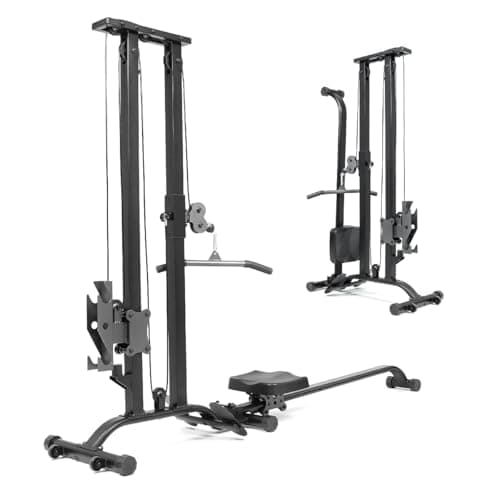
- TOUSAINS Foldable Cable Machine - you rent, or you cannot drill. Folds to 2.92 sq ft, stands 62.99 inches, 400 lb total rating - and the low assembled height makes it the one cable pick that suits a low-ceiling room.
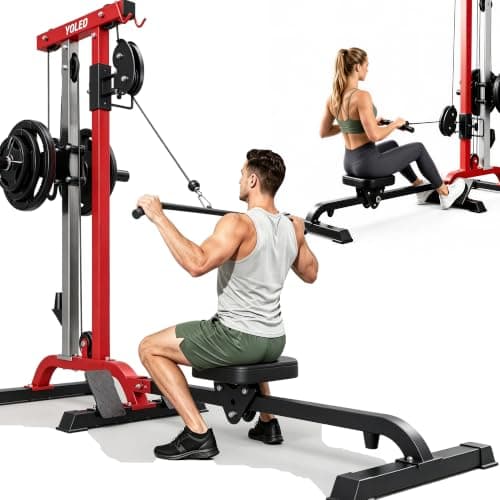
- YOLEO 2-in-1 Cable Machine - you can spare a corner and want more station than tower. Freestanding, more function, a permanent claim on the floor.
What we left off
No full cable crossover. A crossover needs two towers far enough apart to cross cables between them, which is the opposite of compact - there is no small version, only a smaller room with a crossover in it. Ours stays on the main cable machines roundup.
No weight-stack wall station on this page either, even though we rate one elsewhere. A selectorized stack is the nicest way to use cables at home and the stack itself is a large, heavy, permanent object - it belongs in a gym room, not a shared bedroom.
And no resistance-band door anchorssold as “cable machines.” Bands are genuinely useful, genuinely tiny and we recommend a set on several pages, but the resistance curve is nothing like a cable and calling them one would be dishonest. They live on best equipment under $100 and in bands vs. dumbbells.