The short version: you need a cable - or at minimum a pulley hanging off your rack - when you want to load a vertical pull-down and cannot do pull-ups. That is the one movement pattern a standard home gym of dumbbells, a bench and a rack genuinely cannot load, and it is the only reason to buy a cable that we think is non-negotiable.
Everything else a cable gives you - constant tension, pushdowns, face pulls, crossovers, pulling at angles free weights cannot - is a refinement. Real, useful, worth having eventually. Not worth buying before you own dumbbells, a bench and something to pull on.
The one thing cables do that nothing else does
Look at a typical home gym and ask what moves a load downward past your shoulders. Dumbbells row, they do not pull down. A barbell presses and pulls from the floor. A bench holds you up. The rack holds the bar. In most home gyms, nothing loads a vertical pull except your own bodyweight on a bar - and if you cannot yet do a pull-up, that means nothing loads it at all.
That is a real hole. The lats are a big muscle group that responds to being loaded directly, and it is why home-trained backs often end up thick through the middle and underdeveloped at the sides. A pulldown fixes it with a weight you select, which is also the route to a first pull-up. We cover the whole picture in home gym equipment for your back.
The second genuine advantage is constant tension. A dumbbell fly has almost no resistance at the top; a cable fly has the same tension throughout. A dumbbell row goes slack at the bottom; a cable row does not. For accessory and isolation work this is a real difference in training quality - it is just not a difference that matters until the basics are loaded.
The three tiers, and what each needs from you
“Cable machine” covers three quite different purchases at wildly different prices. Knowing which tier you are shopping in is most of the decision.
The three tiers, cheapest first - live prices, last verified October 21, 2026
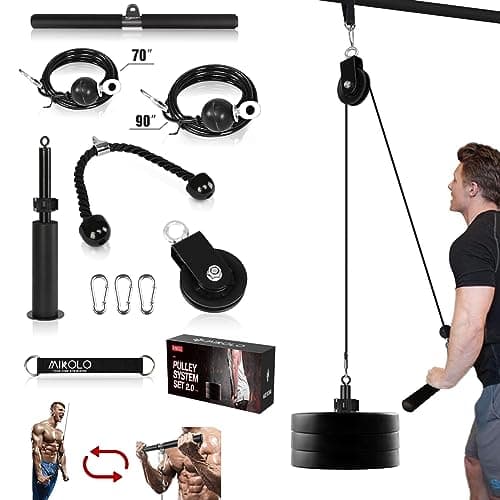
Mikolo LAT and Lift Pulley System
A loading pin, two cables and a pulley that hang off the rack you already own — the cheapest honest way to add cables to a home gym.
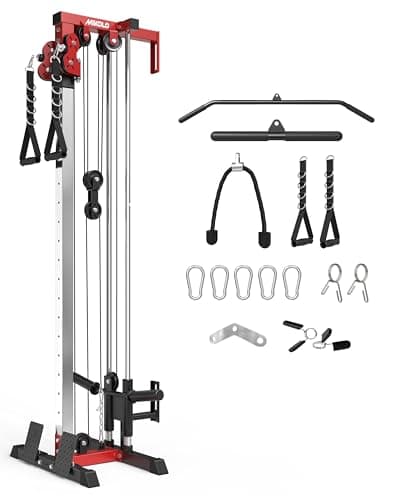
Mikolo Wall Mount Cable Station
A plate-loaded dual-pulley crossover that bolts to a wall and gives you a real cable station for roughly the price of a cheap bench.
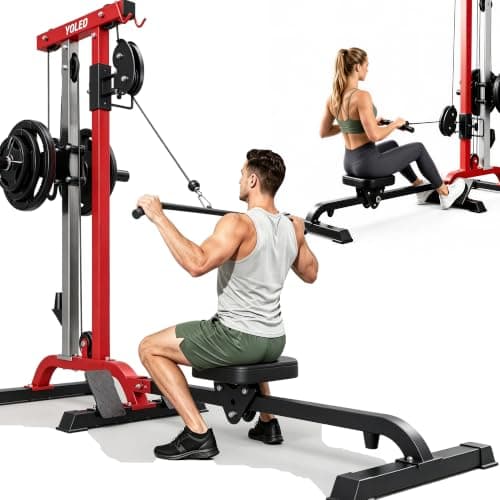
YOLEO 2-in-1 Cable Machine
A freestanding lat-pulldown and row tower that folds upright and needs no wall anchors — the pick if you rent and cannot drill.
#ad · Price as of October 21, 2026 · Affiliate disclosure
Start with the pulley. Genuinely.
If you already own a rack, a pull-up bar or an exposed beam, the rack-mounted pulley is the highest-value purchase in this entire category and it is not close. A loading pin, two cable lengths, a pulley, a straight bar and a tricep rope, rated to 280 lb, weighing under 7 lb, for about a tenth of what a station costs. It does the two movements most people want a cable for - pulldowns and pushdowns - and it stores in a drawer.
The honest limitations, because they are the reason stations exist: one cable path, so no crossovers and no simultaneous high-and-low work. Manual weight changes - you lift plates onto a pin and rethread cable. And no seat, footplate or leg hold-down, which means a heavy pulldown starts lifting you off the floor instead of the weight off the ground. Sit on a bench and wedge your knees, or keep the load sensible.
If you do not own a rack, the pulley is not an option and you are shopping for a station. That is a bigger decision, and it is worth asking whether a rack with a built-in pulley is the better buy - several are, and they are ranked in our rack roundup. One purchase, two problems solved.
When the answer is no
We would tell you to skip it entirely in four situations, and this is the part cable roundups leave out because it sells nothing:
- You can do pull-ups. Then the vertical pull is covered, harder and cheaper, by a bar. See do I need a pull-up bar?
- You do not own a bench yet. A bench makes every dumbbell you own more useful. A cable makes a gym you have not finished building slightly more varied. Order matters - what to buy first.
- Your space is already tight. A station is a permanent footprint or a permanent set of holes in a wall. In a shared room, the folding and renter-safe options in our folding roundup are the better fight to pick.
- You hate loading plates. Every cable option in our registry is plate-loaded. If changing weight by hand every set is going to stop you training, the honest alternative is a pin-select stack machine - our machines roundup ranks those, and free weights vs. machines is the decision page.
Where a cable sits in a sensible buying order
Our position, applied consistently across this site: dumbbells, then a bench, then the vertical pull, then a rack and barbell, then cables. Note that the vertical pull comes third - but the cheapest way to fill it is usually a doorway bar or a rack pulley, not a cable station. The station is a fifth-or-later purchase, bought when the gym is otherwise complete and you want better accessory work.
Costed versions of that order are in the $1,000 Build and the $2,000 Build - and it is worth noting that the $2,000 build includes the $40 rack pulley rather than a cable station, which tells you exactly where we think the value is. The movement-pattern breakdown is in the best equipment for a full-body workout.
Two narrower versions of this question
If the answer is yes but the room is the obstacle, best cable machines for small spaces ranks the options by the floor each one claims when idle - which is the number that decides a shared bedroom. If the obstacle is the price, how much a cable machine costs prices every tier live, from the rack pulley above to a selectorized stack, and adds the plates that none of the plate-loaded stickers include.