The short answer: cables at home cost anywhere from $37.99 to $469.99, and which end you land on is decided by what you already own rather than by how serious you are. If you have a power rack, squat stand, pull-up bar or exposed beam, a hanging pulley system at $37.99 is the whole purchase. If you own nothing, a freestanding folding tower at about $199.99 is the realistic floor.
That is a 10x spread inside one category, which is why “how much does a cable machine cost” has no single answer. Every price on this page is read live from our price layer and was last verified October 21, 2026.
The six tiers, cheapest first
Read the third column before the second. The cheapest row is only cheap conditionally - it needs a frame and plates you may not have. The most expensive row is the only one that includes its own resistance, so its sticker is closer to its true total than any other row here. That is the central arithmetic of this category and it is why the order of the second column is not the order of what you will actually pay.
Plate-loaded or weight stack: the real price difference
Every affordable cable setup is plate-loaded. You hang Olympic or standard plates on a pin, and the machine costs a fraction of a commercial one because the heaviest, most expensive component - the stack - has been removed and handed to you as homework.
If you already own plates, that is a gift: $37.99 for pulldowns and pushdowns is unbeatable. If you do not, add the plates to the price. Plates run roughly $1 to $2 per pound, so even a modest 100 lb of loading is a real line item - how to choose weight plates covers what kind to buy, and check whether the loading pin takes 1-inch standard or 2-inch Olympic holes before ordering anything.
A selectorized stack at around $469.99 removes all of that: you move a pin, the weight changes, no plates exist. For most home gyms it is more money than the category deserves. For a shared household gym where three people train at different weights and nobody wants to re-load a pin, it is the version people actually use.
What the price does not include
- Plates, on every option except the stack. See above - this is the big one.
- Something to hang the cheap one from. A rack pulley with no rack is not a purchase, it is a plan. Racks start around $170 for a stand with safety arms: how much a power rack costs.
- Fixings and a stud finder for wall-mounted options, plus a wall you are allowed to drill. Renters should assume this tier is closed to them - wall-mounted vs. freestanding applies the same test to racks.
- Floor space, priced in square feet of your room. The honest currency for a crossover is not dollars; it is the corner it never gives back. Our compact cable picks rank by the floor each one claims when idle.
- Attachments you will want. A lat bar, a rope, a single handle. Most kits include one or two; the third is an extra $20 to $40.
What we would buy at each budget
The tiers in practice. These are the three we would actually buy, in the order the decision usually runs - and the decision runs on what you own, not on the price.
The three honest tiers - live prices, last verified October 21, 2026
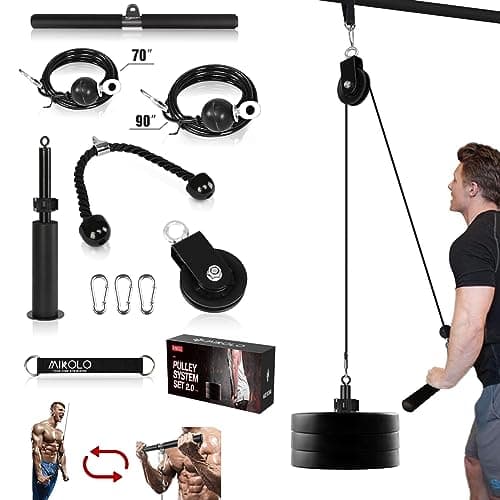
Mikolo LAT and Lift Pulley System
A loading pin, two cables and a pulley that hang off the rack you already own — the cheapest honest way to add cables to a home gym.
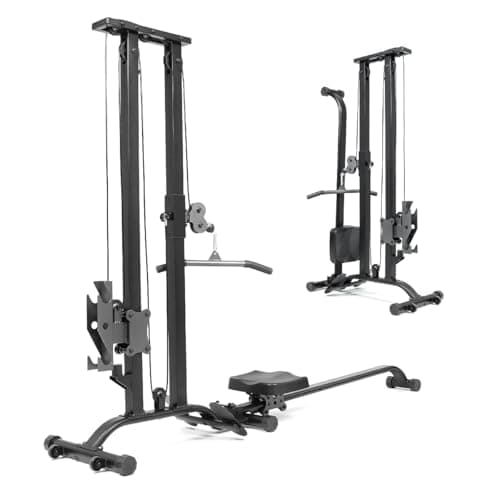
TOUSAINS Foldable Cable Machine
Just under 63 inches tall and folds to under 3 square feet — the only pick here that fits a 7-foot ceiling and a closet.
#ad · Price as of October 21, 2026 · Affiliate disclosure
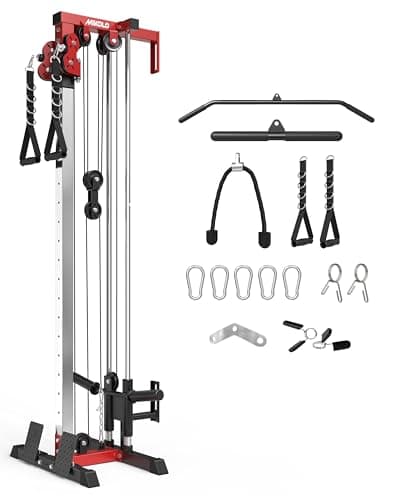
Mikolo Wall Mount Cable Station
A plate-loaded dual-pulley crossover that bolts to a wall and gives you a real cable station for roughly the price of a cheap bench.
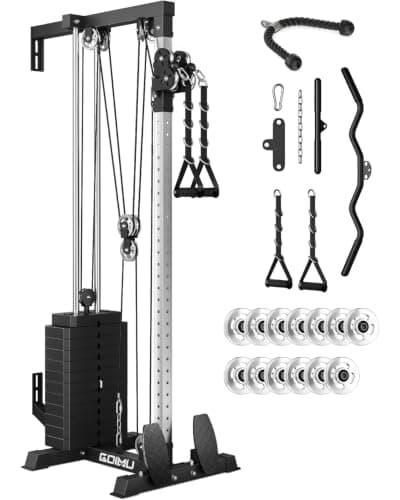
Goimu WM2-V4 Wall Mount Cable Station
A 155 lb selectorized stack that also takes plates — pick your weight with a pin instead of carrying iron around.
Is any of it worth it?
For one reason, yes: a loaded vertical pulldown. If you cannot do pull-ups, nothing else in a dumbbell-bench-rack gym trains that pattern with a weight you choose, and at $37.99 the fix is almost free. That single argument is the whole case for cables at home.
For every other reason, be sceptical. Constant tension, crossovers, pushdowns and face pulls are genuinely nice and genuinely optional, and a cable is a poor fourth purchase for someone who does not yet own dumbbells, a bench and something to rack a bar on. Our do I need a cable machine guide is written to talk you out of it where that is the right answer, and the $1,000 build shows where a $40 pulley fits once the essentials are covered.