What the expansion model actually costs you
Worth doing the structure of the arithmetic even without dollar figures, because it is not obvious from a product page.
A PowerBlock Elite USA buyer who wants 90 lb a hand makes three purchasesaccording to PowerBlock's own store: the base pair, then the Stage 2 kit to reach 70 lb, then the Stage 3 kit to reach 90 lb - and Stage 3 cannot be used before Stage 2. A Pro 100 EXP buyer who wants 100 lb makes four, across Stages 2, 3 and 4 at 20 lb a stage. Add a stand if you want one, because the store sells those separately too.
Two things follow from that, and they pull in opposite directions:
- In favour of the model: your day-one cost is lower, your pair never becomes the wrong pair, and you only pay for the weight at the point you can actually lift it. For someone genuinely unsure whether they will train, that is a real argument.
- Against it: the total for a 90 lb ceiling is several purchases over several years, every one of them at whatever the price is on the day, and the increments arrive in fixed 20 lb lumps rather than when you want them. Buying a single 52.5 lb pair outright is one decision and one price.
Our how much do adjustable dumbbells cost guide prices the whole category off the live layer, and are adjustable dumbbells worth it? is the prior question.
The one thing none of these replaces
Be clear about this before you buy anything on this page: nothing in our registry reaches 80 or 90 lb per hand except the NUOBELL, and nothing here expands by kit at all. If your reason for shopping PowerBlock is specifically the 90 or 100 lb ceiling, then no alternative on this page matches it, and we are not going to pretend otherwise.
What we would say to that reader is the same thing our NUOBELL page says: a lifter strong enough to need 90 lb in one hand is almost always better served by a barbell, plates and a rack than by a heavier dumbbell. Two 90 lb dumbbells is 180 lb of load with no squat, no deadlift and no bench safeties. The same money in a bar, plates and a rack under $500 has a far higher ceiling.
The second thing none of these replaces is the block shape itself. A PowerBlock is a rectangular cage you put your hand inside, which is why it is so short end-to-end - the Pro 50 frame is published at 13 by 7 inches. Every pick below is either a round-headed dial dumbbell or a conventional hex pair, both of which are longer at the same weight. If you have been using blocks and you like how they rack in a tight space, that is a genuine preference and no alternative here reproduces it.
What each alternative gives you, and gives up
The middle column is the honest comparison. PowerBlock's published increments are 2.5 to 5 lb on the Elite USA and 3 lb on the Sport 24; the 552 does 2.5 lb steps to 25 lb and 5 lb above that, the TELK does 2.5 lb steps throughout, and the fixed hex sets jump 5 lb or 10 lb a pair. If small increments are what you liked about the blocks, the dial pair and the plate-loaded pair are the two that keep them.
One spec to read literally: the TELK handles and plates are 1.15 inch, not the standard 1 inch. That matters precisely because it is the pick that grows - any add-on plates have to match that bore. We state it on every page the TELK appears on.
Who each pick is for
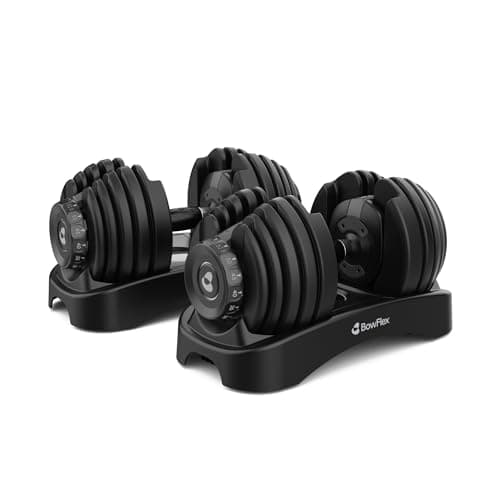
- Bowflex SelectTech 552 (Results Series) - most people leaving PowerBlock. One dial, 5 to 52.5 lb, 2.5 lb steps where they matter most, and the shortest list of things to buy afterwards: none. Buy this current Results Series listing - older 552 units sold through May 2025 are under a CPSC recall, and a secondhand pair is not worth the risk.
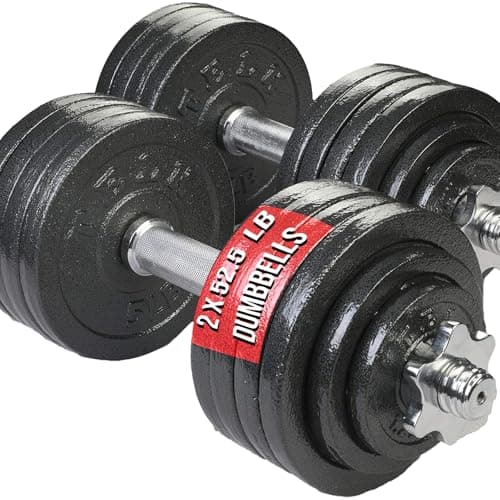
- TELK 105 lb adjustable set - you specifically liked the idea of a dumbbell that grows. Plate-loaded to 52.5 lb a hand in 2.5 lb steps for a fraction of any dial pair, and you add weight with plates rather than with a proprietary stage kit. Slower to change between sets than a dial, and the 1.15 inch bore is a real constraint.
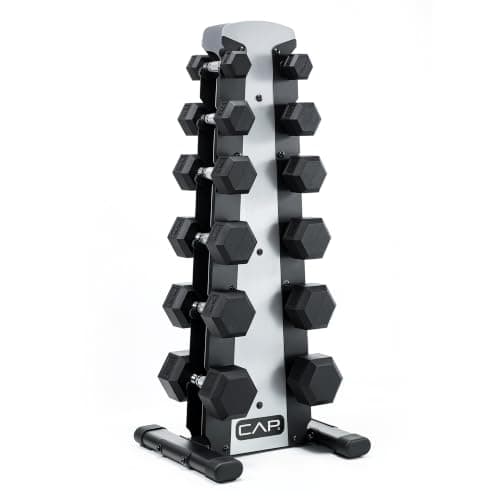
- CAP 210 lb rubber hex set with rack - you want nothing that can break. Six fixed pairs from 5 to 30 lb on a vertical rack about 46 inches tall: no dial, no pin, no plates to lose, and you can grab two different weights for a superset without adjusting anything. Takes more floor than a block pair.
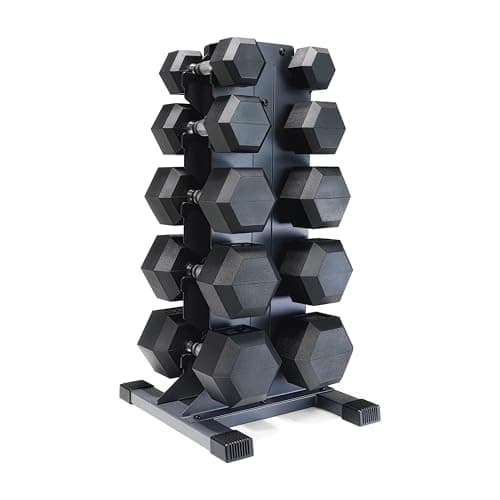
- CAP 300 lb rubber hex set with rack - you want a genuinely heavy ceiling in fixed pairs. Five pairs from 10 to 50 lb, which is the heaviest fixed pair we rank. The jumps are 10 lb, which is coarse for pressing and fine for rows.
- LifePro Powerflow Plus- you want a compact dial pair and the stand included rather than sold separately. 5 to 25 lb a hand, which is roughly the bracket PowerBlock's own lightest sets occupy, and it comes with its rack.
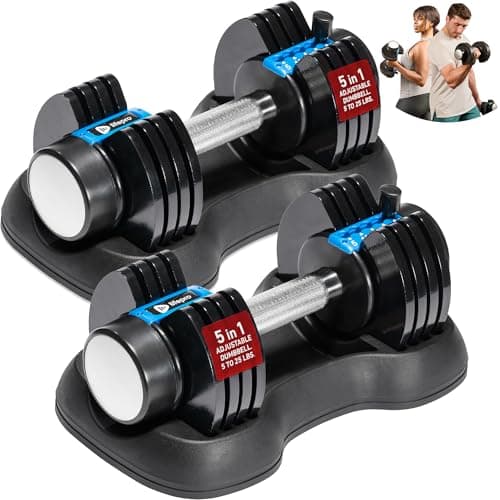
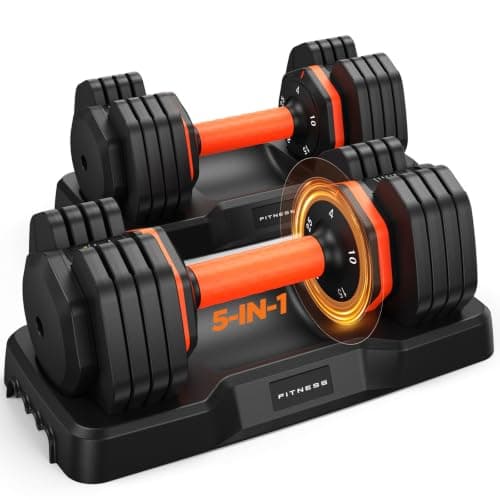
- 5-in-1 adjustable dumbbell set - the budget pick, and the right call if you are at the start rather than the middle of this. Up to 25 lb a hand with quick-lock plates and a storage box. If you outgrow it, you have lost very little and learned what you actually use.
Three cases where buying the PowerBlock is right
A page like this is only useful if it says when the original wins. Three cases:
- You want more than 52.5 lb a hand in a dumbbell. PowerBlock publishes 90 lb on the Elite USA and 100 lb on the Pro 100 EXP. Nothing in our registry gets there except the NUOBELL at 80 lb, and no pick on this page does.
- Floor and shelf space is the binding constraint. The block form is short end-to-end - PowerBlock publishes 13 by 7 inches for the Pro 50 and 10 by 5.5 inches for the Sport 24. A round dial dumbbell at the same weight is longer.
- You want to spread the cost deliberately. Paying for 50 lb now and 90 lb in two years is a legitimate plan, and the expansion kits are exactly that product. None of our picks offers it.
In all three cases, go to powerblock.com for current pricing on the pair you want plus the kits you will eventually need - we deliberately do not reproduce their figures here.
What we left off, and why
No buy link for PowerBlock, anywhere on this page. We hold no verified listing for it, and a page that cannot stand behind the listing has no business sending you to one.
No price for PowerBlock or its kits. Their store publishes those figures and they change; this site reads its own prices from a live layer and never types one in by hand, so quoting a competitor's number once would be the one hardcoded price on the whole site.
No dumbbell stand. "PowerBlock stand alternative" is a live autocomplete completion and our registry holds no verified standalone dumbbell stand - two picks here include their own rack, which is the closest honest answer.
No NUOBELL on this page, deliberately, even though it is the only pair we rank that approaches PowerBlock's top end. It has its own alternatives page, and the question there - do you need 80 lb a hand - is the one a 90 lb PowerBlock shopper should read next.
And no invented equivalences. We have not weighed, dropped or dialled a PowerBlock. Every figure attributed to them above is a quotation from their own store, dated, and every figure attributed to our picks is from the live listing.