Who it’s for
The Marcy MWM-988 is for the person whose honest answer to “why aren’t you training?” is “I don’t know what I’m doing and I’m training alone.” Everything about this machine is built around removing that objection. The weight is on a pin, so there is nothing to load. The paths are fixed, so there is no technique to learn before you can start. And nothing can land on you, because nothing is ever above you unsupported.
That makes it a genuinely good fit for three situations. An older beginner, or anyone returning to training after a long gap, who wants to build strength without first learning to brace under a barbell - our equipment for seniors page ranks it for exactly that reason. A household where more than one person will use it, because a pin-select stack means a 40 lb user and a 120 lb user can swap in four seconds. And anyone whose deal-breaker is safety while training solo, which is a far more common and reasonable concern than the barbell internet admits.
Who should not buy it? Anyone who wants to get strong rather than to start training. 150 lb is a hard ceiling and you cannot add to it. If that is you, the honest recommendation is a rack, a bar and plates for similar money - our all-in-one squat racks page covers frames that also give you a cable, and weight machine vs. free weights at home lays out the whole trade-off as a purchase decision rather than an argument.
What you actually get
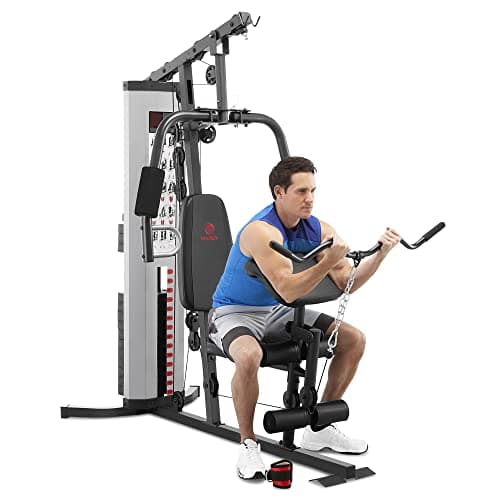
Marcy publishes the core of it plainly. A 150 lb selectorized weight stack with a safety lock, held in place by guard rods during use. Dual-action press arms that do both a chest press and a vertical butterfly - you change which by removing and reinserting a pin, not by rebuilding anything. A removable, adjustable preacher curl pad for isolated biceps work. A leg station integrated into the same frame as the arm stations. Seats with high-density boxed upholstery. The whole thing is heavy-duty steel tubing and the published unit weight is 280.5 lb.
The number that matters most there is the least glamorous one: 150 lb, on a pin. Everything good and everything limiting about this machine follows from it. Pin-select load is the single biggest quality-of-life feature in strength equipment - it is why commercial gyms put selectorized machines in the circuit area and plate-loaded equipment in the free-weight room. You move one pin and the weight changes. There is no loading, no unloading, no plate storage, no clanging iron, and nothing to drop on a foot.
What is not in the box: a barbell, plates, a bench you can move, or any way to train a movement the frame does not have a station for. That is not a criticism - it is the deal. A multi-gym is a closed system, and you are buying its exercise list rather than a platform you extend later.
What a week of training on it looks like
Spec lists are easier to read than they are to train from, so it is worth laying the stations against an actual week. Marcy’s own description covers four things: the dual-action press arms, the high and low pulley work the stack drives, the removable preacher curl pad and the leg station. That is enough for a credible two-day rotation, and it is honest about where the gaps are.
- Day one, push. Chest press from the press arms, then re-pin them to the butterfly position for a second angle on the same muscles, then tricep work off the pulley. Two seated positions, one pin change, no plates.
- Day two, pull and legs. Pulldowns or rows depending on how the pulley is configured, the preacher curl pad for biceps, and the leg station for knee extension and flexion work. The leg station is the part most people underuse and the part that runs out of weight soonest.
What is not in that week is worth naming: no squat, no deadlift, no overhead press with a free load, no carrying anything, and nothing that asks one side of your body to work harder than the other. Those are real holes - the hip hinge in particular is the single most useful pattern a home gym can train, and no machine in this price band loads it properly. If you want them, a pair of adjustable dumbbells and a mat covers most of the list for very little money, and our full-body dumbbell workout is written for exactly that kind of supplement.
One practical note on the pin. A selectorized stack has fixed increments, usually 10 lb, and that is coarse for small muscles - going from 20 lb to 30 lb on a tricep pushdown is a 50% jump. The fix is the same as on a fixed dumbbell set: add reps and sets before you add weight, which our progressive overload guide walks through.
What it does well
It removes nearly every reason a beginner skips a session. We say this about fixed dumbbell sets too, and it is even more true here. There is no equipment friction at all: you sit, you move a pin, you train. For someone whose training history is a series of three-week attempts, the machine that asks the least of you before the first rep is often the machine that gets used. A year of mediocre sessions beats three weeks of optimal ones.
The dual-action press arms earn their name. Getting both a horizontal press and a vertical butterfly out of one mechanism with a pin swap is more than most budget multi-gyms manage - plenty of frames in this price band give you one chest movement and call it a chest station. Two different loading angles on the pecs from one seat is the single most useful thing on the machine after the stack itself.
It is the cheapest selectorized stack a known brand sells. This matters more than it sounds. The weight stack is the expensive part of any machine - steel plates, machined guide rods, a pulley train - and plenty of cheaper frames reach their price by being plate-loaded instead, which quietly puts the cost of plates back on you and takes the pin-select convenience away. Marcy has been building this frame for years, parts exist, and the company backs it with a two-year limited manufacturer warranty. That is a different proposition from a no-name machine at the same price.
And it is safe in a way free weights are not. Nothing on this machine can fail onto you. There is no bar to get stuck under, no dumbbell to drop, no need for a spotter and no need for safety arms set at the right height. If you are training alone in a basement and that worry is what has stopped you buying anything, read how to train without a spotter - and then note that this machine solves the problem by removing it entirely.
Where it falls short
150 lb is the ceiling, and it is not adjustable. This is the honest headline limitation. Pressing runs out first: with the pulley ratios a frame like this uses, a 150 lb stack stops being a hard chest press for a consistently training adult inside a year. Legs run out sooner - a leg developer working against 150 lb is a light exercise for most people from fairly early on. And unlike a barbell, where getting stronger means buying one more plate, there is no cheap upgrade path. When you outgrow a selectorized stack you replace the machine.
Guided paths do not teach you to lift. The press arms move where the machine moves them, which is exactly why the machine is safe and exactly why it builds less of something. Bracing a load, keeping a bar balanced, controlling a weight through a path your own body has to decide - those are the things that transfer to carrying furniture, picking up a child, and every barbell you ever touch afterwards. A machine-only year leaves you stronger in the machine and less prepared outside it. We go through this properly in free weights vs. machines.
280 lb is a one-way decision. This machine does not fold, tilt, wheel or come apart for storage. Once it is assembled in a corner it is furniture, and moving it later means partly dismantling it - our moving equipment guide covers how much work that really is. Measure the room, the door and the ceiling before the boxes arrive, not after. The 78 inch height is the figure most likely to catch out a basement.
The exercise list is fixed.With a barbell and a rack, the same equipment covers squats today and good mornings next year because you decide what to do with it. Here, the machine has stations and those stations are the complete list. If you later want Romanian deadlifts, farmer’s carries, overhead pressing or anything unilateral, you are buying more equipment - most likely a pair of adjustable dumbbells, which is genuinely the best companion purchase to a machine like this.
The verdict
The Marcy MWM-988 is the right machine for a specific and perfectly respectable set of reasons, and the wrong one for the reason most people think they want it. It is not a shortcut to being strong; a 150 lb stack cannot do that, and no honest page should imply otherwise. What it is, is the lowest-friction, lowest-fear way to start resistance training at home from a brand that has been making the frame long enough for parts to exist - and we rank it first on our best home gym machines page because nothing else at the price does that as well.
Buy it if you want to train alone with nothing that can fall on you, if more than one person in the house will use it, if a pin beats loading plates for you, or if the real goal is consistency rather than a number. Add a pair of adjustable dumbbells within the first few months - that one purchase fills most of the holes in the exercise list for very little money.
Buy something else if you already know you want to squat and bench heavy. For similar money a squat rack with a cable system gives you no weight ceiling, the lifts that actually transfer, and a platform you keep adding to - our all-in-one squat racks page is where to start, and weight machine vs. free weights is the two-minute version of the decision. There is no wrong answer here - just two different machines for two different people, and it is worth knowing which one you are before 280 lb of steel arrives at the door.