Plates or a pin? This is the decision
All four of these machines give you two adjustable pulleys. What separates them, and what the price difference is really buying, is how the weight gets on the cable.
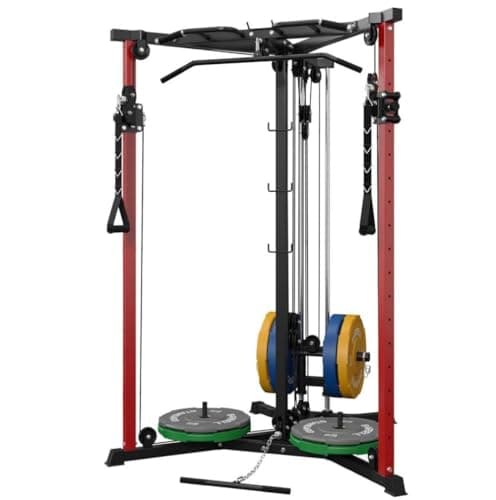
- Plate-loaded. You hang your own Olympic or 1-inch plates on a loading pin. Cheap, mechanically simple, and the ceiling is however many plates you own. The cost is friction: every weight change is a trip to the plate post, which quietly kills supersets and drop sets. The Mikolo crossover and the Mikolo wall station work this way.
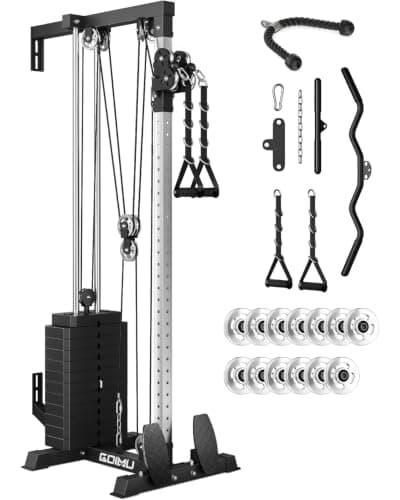
- Selectorized stack. A stack of steel plates and a pin. A weight change takes a second. The cost is money and a hard ceiling - the Goimu is 155 lb, the folding rack 100 lb - though the Goimu also accepts plates on a pin, which is the best of both.
Here is the part that catches people out. Several of these run a 2:1 pulley ratio, which halves the load and doubles the cable travel - hang 100 lb and you feel roughly 50. The Goimu ships a 2:1 adapter deliberately, so you can drop to half weight for light, high-rep work. The folding rack runs 2:1 as standard, which is why its 100 lb stack is lighter in practice than the number suggests. Neither is a flaw. Both mean you cannot compare two load figures without first checking the ratio behind them.
What each frame asks of your room
Read the middle column before the price. Three of these four have to be bolted into a wall, and the Goimu’s listing goes further and specifies concrete or masonry - which rules out a stud wall as well as a rental. That is not a small caveat; it is the single most common reason a cable station gets returned. If you cannot drill, the Mikolo crossover is your only pick on this page, and you pay for it in floor: about twenty square feet that does not come back.
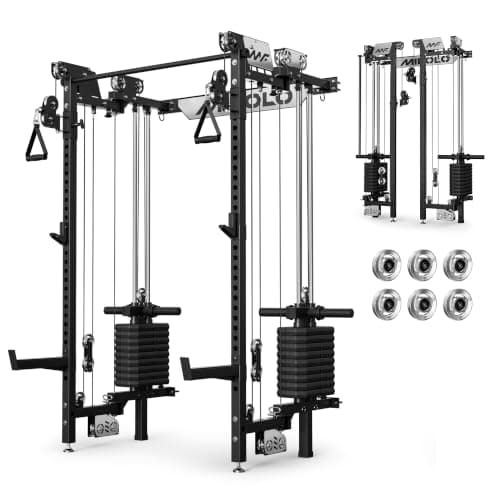
The folding rack is the interesting exception. It bolts in permanently - so it is emphatically not a renter’s purchase - but when folded it gives the room back at a published 3 square feet. If the gym shares a space with a bedroom or an office, that is worth more than any other number on the page. Our best cable machines for small spaces page ranks the whole category on exactly that question, including single-cable options this page excludes.
What a functional trainer actually replaces
Worth being precise, because this is a four-figure-adjacent purchase in some cases:
- It replaces cable work you cannot do with free weights. Face pulls, cable flyes, triceps pushdowns, woodchops, single-arm rows against constant tension, and anything where the resistance needs to come from the side rather than from underneath. That is a real gap in a barbell-and-dumbbell gym.
- It does not replace a squat rack. No cable machine lets you put a loaded barbell on your back safely. If you want both from one frame, buy a cage with the pulleys built in - best all-in-one squat racks ranks that class, and it is usually cheaper than a bare cage plus a separate trainer.
- It does not replace a bench or dumbbells. Pressing from a cable is a different movement from pressing a dumbbell, and most people want both.
If you are not sure the category is worth it at all, do I need a cable machine for a home gym makes the honest case both ways, and functional trainer vs. power rack settles which to buy first if you can only have one.
Who each pick is for
- Mikolo Cable Crossover - you rent, or you simply will not drill. The only freestanding dual-pulley trainer here, with a pull-up bar on top. You pay in floor space: around 20 square feet, permanently.
- Goimu WM2-V4 - you are done carrying plates. A 155 lb pin-select stack with 33 height positions, aluminium pulleys, and a plate pin so the stack is not a hard ceiling. Needs a concrete or masonry wall.
- Mikolo folding wall rack - the gym shares the room with something else. Dual independent pulleys, its own 100 lb stack, and it folds to a published 3 square feet. Permanent wall fixing, and the most expensive pick here.
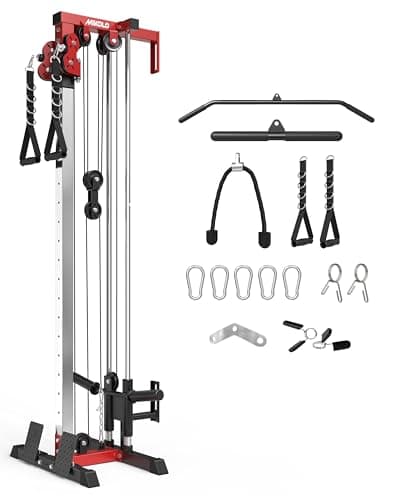
- Mikolo Wall Mount Station - the budget pick. A real dual-pulley crossover with 19 heights, a 400 lb load rating, and the lat bar, cable bar and rope in the box. You bring the wall and the plates.
What we left off, and why
No single-cable lat and row towers. They are good machines and two of them are picks on other pages of this site - but one cable is one cable, and a page titled “functional trainer” that included them would be using the term the way marketing does rather than the way it means something. They are ranked on best lat pulldown machines, which shares no picks with this page.
No power cages with dual pulleys, even the ones that technically qualify. Nobody buys a 500 lb four-post cage for its cables - they buy it to squat in, and the cable system is the reason to pick one cage over another. That decision belongs on best all-in-one squat racks.
No selectorized multi-gyms. A seated machine with press arms and a leg developer is a different purchase entirely; those are on best home gym machines.
And no invented pulley ratios. Where a listing does not state whether a load figure is per-pulley or whole-machine, or whether the cable runs 1:1 or 2:1, we have left it as published rather than filling the gap. It is the single easiest spec to get wrong on this type of machine, and a confident wrong number is worse than an honest silence.