Step one: measure, at the navel
Do this before you look at a single belt. Stand relaxed, run a flexible tape around your bare waist level with your navel, and breathe normally. That number is your belt size.
- Not your pants size. Trousers sit on the hips, well below where a belt goes, and the difference is usually three to four inches.
- Between two sizes? Go up. Both RDX listings and the Dark Iron listing say this in their own feature text. A belt that is slightly large still has holes left to tighten; one that is slightly small is unusable.
- Check the published range, not the letter.“Medium” means 29-33 in on the Harbinger, 30-35 in on the RDX powerlifting belt and something else again on an unbranded belt. The letters are not standardized; the inches are.
Two of the picks here publish full inch ranges for every size - the Harbinger (S 24-29, M 29-33, L 33-37, XL 37-42) and the RDX IPF belt (S 25-30, M 30-35, L 35-40, XL 40-46). Where a listing only gives a size image, we have said so in its cons.
Step two: closure - roller, prong or lever
A roller buckle is the nylon-belt standard and the easiest thing to use: thread, pull, done, one hand. Fast enough that you will actually take it off between sets, which matters more than lifters admit.
Two prongs is the leather standard. It is the most secure mechanical closure - nothing to slip, nothing to wear out - and it is slower, needing two hands and a moment. A prong belt is the right default if you want leather and do not want to think about hardware again.
A lever is one hand, one click, and exactly the same tension every single set. That consistency is the real argument for it. The cost is that changing the tension means unscrewing the lever and repositioning it, so a lever suits a stable waist and suits someone who has already found the hole they like. It is also where cheap belts fail: the lever is a stamped metal mechanism under load, and the pick here names its hardware (Camac steel) precisely because that is the part that bends on a bad one.
What is not on this page: velcro-only belts with no second closure. A hook-and-loop strap alone can peel open under a maximal brace, and that is the one belt failure with consequences. The cheapest pick here uses velcro plus a tension roller buckle working together, which is a different thing.
Step three: thickness, and why 13 mm is usually wrong
Leather belts come in roughly 6.5 mm, 10 mm and 13 mm. Thicker is more rigid, which means more to brace against - and more to break in, less comfort, and more belt than most people can use.
10 mm is the answer for nearly everyone who wants a leather belt. It is rigid enough for a heavy squat, legal in every major federation, and it softens into shape over a few weeks. Both leather picks aimed at heavy work here are 10 mm, and the RDX listing offers 13 mm as a separate option.
13 mm is for competitive powerlifters at genuinely high loads. It takes months to break in, it is uncomfortable to sit in, and if you are not pulling near your limit it is doing nothing extra. Buying 13 mm as a first belt is the most common over-purchase in this category.
Nylon sits below all of it for rigidity and above all of it for comfort and convenience, which is exactly why it is our top pick for a home gym rather than a platform. If you are squatting and pressing two or three times a week and not chasing a record, nylon is not a compromise - it is the correct tool.
What about the 6-inch belt?
Federation rules cap belt width at 4 in, so a 6 in belt is a training-only belt by definition. It is here for one reason: spreading the same pressure over more of your back makes bracing more comfortable, and “belts hurt” is the commonest reason a belt stops being worn.
The catch is torso length. Six inches of belt between your ribs and your hips is a lot, and on a short-torso lifter it jams into the ribcage when you sit into a squat. If you are under about 5 ft 7 in, measure the gap before you buy one. If a 4 in belt has always dug into your sides, this is the pick to try.
Who each pick is for
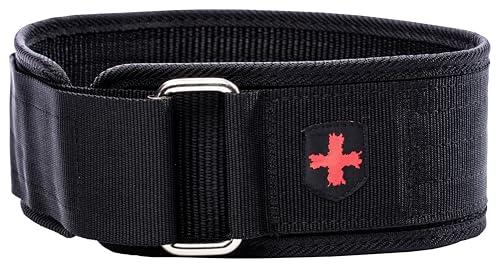
- Harbinger 4 in nylon - the default home gym belt. Nylon web with a 3 in support strap, 346-count stitching down the full length, a heavy-gauge steel roller buckle, and published waist ranges for all four sizes. Flexible, fast, comfortable. Not as rigid as 10 mm leather and not federation-legal - it is a training belt, and that is what you need.
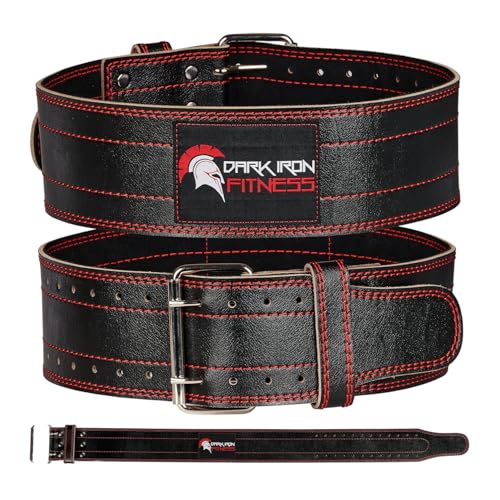
- Dark Iron Fitness 4 in leather- you want real leather without a premium price. Double-row stitching, a double-prong buckle, and 12 holes at 1 in intervals across a published 22-49 in range from XS to XL, which genuinely covers petite to large. Expect a few stiff weeks of break-in. Note the listing’s own text calls the buckle a “double-prong metal lever buckle”, which describes two different closures; the title and the images say double prong.
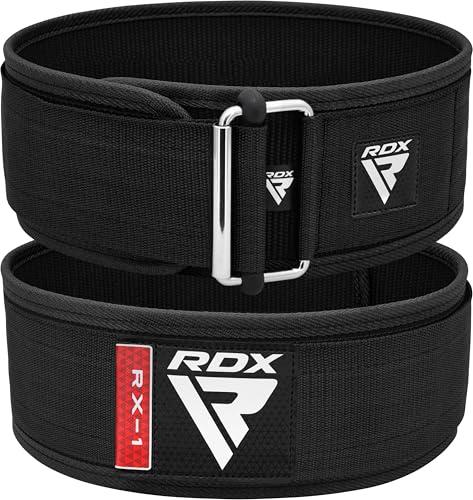
- RDX Auto-Lock 4 in nylon - the cheapest belt here that does not compromise on the thing that matters. An auto-lock tension roller buckle plus a long hook-and-loop strap, so the two closures back each other up. Textured nylon with piped edges. The velcro will lose grip after a few years of sweat and chalk, and the listing publishes no inch ranges.
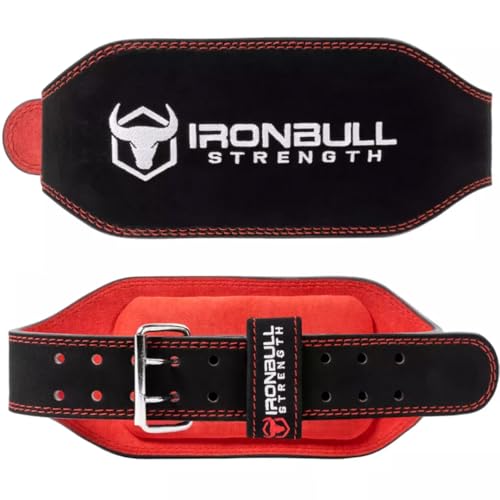
- Iron Bull Strength 6 in padded suede - 4 in belts dig into you. Six inches of even width, padded suede over a full leather backing, double roller buckle with zinc-plated steel prongs. Comfortable enough to actually brace in. Less rigid than unpadded leather, not federation-legal, and genuinely too tall for a short torso.
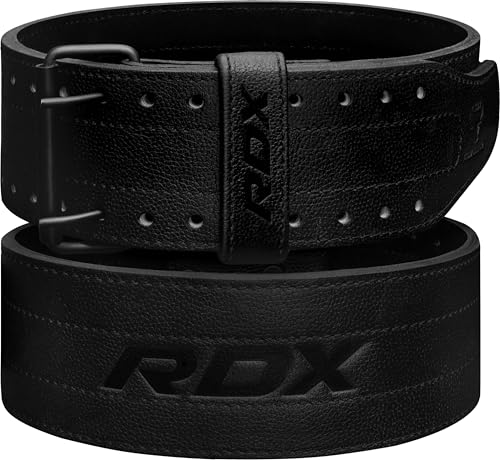
- RDX IPF-compliant 10 / 13 mm - you are lifting heavy, or you intend to compete. A uniform 4 in belt built to published IPF, USPA and IPL criteria, multi-layer cowhide with a suede interior and steel rivets, 12 holes, and real inch ranges. Thickness and size are both separate options on the one listing, so confirm both in the cart.
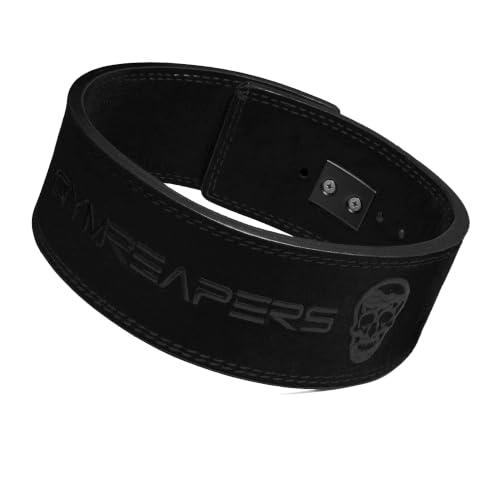
- Gymreapers 10 mm lever - you want the same tension every set and you are willing to pay for hardware that will not fail. IPF, IPL, USPA and USAPL approved, bovine leather with a suede exterior, a Camac steel lever, handcrafted in North America. Several times the price of a nylon belt, and changing the tension means a screwdriver.
What we left off, and why
No velcro-only belts. Covered above, and worth repeating: a single hook-and-loop closure can peel under a maximal brace. It is a cheap belt category and we are not ranking any of it.
No back-support or “lumbar” braces sold alongside lifting belts. Those are medical or occupational products with an entirely different purpose - they immobilize, where a lifting belt gives you something to push against. If you have a back injury, that is a conversation with a clinician, not a purchase decision.
No tapered belts - wide at the back, narrow at the front. They are comfortable and popular for bodybuilding-style training, but uniform width is what a brace actually wants, and no tapered belt is federation-legal. The padded 6 in pick here solves the same comfort problem without narrowing where you need the pressure.
And no unbranded “IPF” lever belts at a fraction of the price. Several turn up in search with competition claims and no named hardware. The lever is the failure point on a lever belt; if a listing will not tell you what the mechanism is made of, we will not rank it.
When to actually put it on
A belt earns its place on the heavy sets of a squat, a deadlift, an overhead press and a loaded carry - the lifts where an abdominal brace is the limiting factor. Those are precisely the lifts a home gym is built around, which is why a belt is worth owning.
Train your warm-up sets and your lighter work without it. A belt is a tool for the top of the session, not a garment, and bracing unbelted is a skill you need to keep. How to breathe when lifting covers the brace itself, which is the part the belt is only amplifying.
And for the record on priorities: if you are choosing between a belt and a rack with safety arms, buy the rack. The belt lets you lift slightly more; the safeties are what let you fail a rep alone and walk away. How to train without a spotter makes that case properly, and how to choose a lifting belt is the long version of this page.