Skip to content

01

Best Pull-Up Bars for a Home Gym

The best pull-up bar is the one your room will actually take. Work out what you are allowed to drill into first, and the choice makes itself.

By Stephen V., Home-gym enthusiastLast updated October 30, 2026How we pick
Affiliate disclosure: Barbell & Bench earns a commission when you buy through our links, at no extra cost to you. We only make money if you buy — never for recommending. How this works.

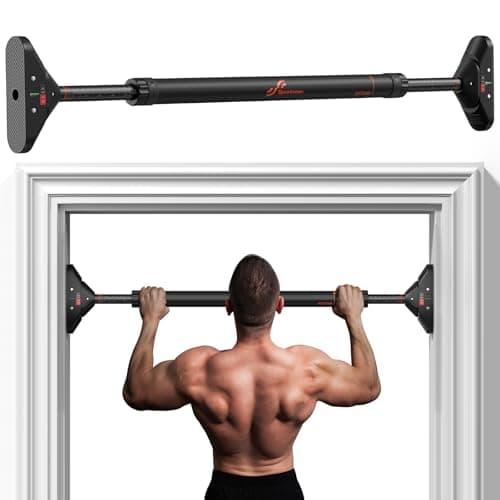
If you rent, the answer is the Sportneer no-drill doorway bar. It clamps into a solid wood door frame between 29.5 and 37 in wide, carries a published 440 lb, and leaves nothing behind but the risk that paint lifts when you take it off - which the listing warns about directly. It is also independently tested to ASTM and EN957, which almost nothing else in this price range publishes.

Everything else on this page is a variation on one question: what are you allowed to put a hole in? That single constraint decides the purchase, and it overrules capacity, grip count and price. Nobody has ever regretted buying the cheaper bar that fit their room; plenty of people have a 440 lb wall mount in a cupboard because their walls turned out to be drywall over a cavity.

So, in order of how little permission you need: a doorway bar needs none. A free-standing power tower needs none either, but it claims a patch of floor roughly 44 x 38 in and never gives it back. A joist or ceiling mountneeds a drill, exposed or locatable timber joists, and your landlord’s indifference. A masonry wall mount needs concrete or brick - and in most US interiors you do not have that, which is the single biggest reason wall-mounted bars get returned.

One more thing before the picks. A pull-up bar is the best value-per-dollar item in a home gym and also the most frequently abandoned, because a pull-up is hard. If you cannot do one yet, buy a bar and a band - a looped band under the knee is what turns a bar you cannot use into a bar you train on three times a week. Our how to do pull-ups at home guide covers the progression.

Prices below come from our live price layer and were last verified November 12, 2026. Every capacity and dimension quoted is the maker’s own published figure; we have not installed or load-tested any of these bars.

02

The picks, ranked

Six bars - ranked by where each one mounts

#ProductBest forScorePrice
1
Sportneer No-Drill Doorway Pull-Up Bar

A no-drill doorway bar rated to 440 lb — adds the single best upper-back exercise without touching the wall.

Renter pull-ups7.8
$39.99 · View on Amazon

$49.99 20% off

#ad · Price as of November 12, 2026 · Affiliate disclosure

2
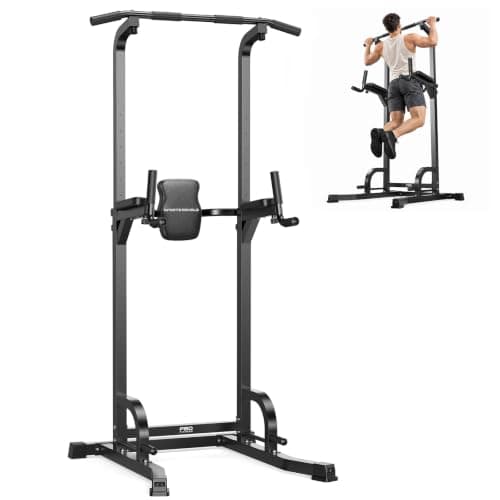
SPORTSROYALS Power Tower

A free-standing frame that needs no drilling at all: pull-ups, dips, knee raises and push-ups from a bar that adjusts across 8 heights.

Best no-drill frame8.3
$139.99 · View on Amazon

$149.99 7% off

#ad · Price as of November 12, 2026 · Affiliate disclosure

3
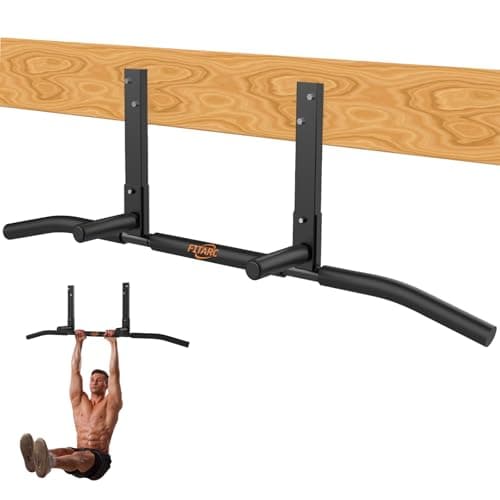
Fitarc Joist Mount Pull Up Bar

The cheapest bar here that will not budge: a 440 lb-rated steel bar that bolts straight to a wooden joist or beam.

Best value mount8.1
$39.99 · View on Amazon

#ad · Price as of November 12, 2026 · Affiliate disclosure

4
Ultimate Body Press Ceiling Mount Pull Up Bar

The ceiling mount with reversible risers that fit both 16 in and 24 in joist spacing - the one compatibility question most mounts fail.

Best ceiling mount8.4
$89.95 · View on Amazon

#ad · Price as of November 12, 2026 · Affiliate disclosure

5
SELEWARE 24 in Height-Adjustable Ceiling Pull Up Bar

The only mount here with four height settings - which is how you get a usable bar out of a ceiling that is too low or too high.

Best for an awkward ceiling8.0
$89.99 · View on Amazon

#ad · Price as of November 12, 2026 · Affiliate disclosure

6
OneTwoFit Wall-Mounted Pull Up & Dip Station

Pull-ups, dips and leg raises off one wall bracket - as long as the wall is concrete or brick, which the listing is explicit about.

Best wall mount7.9
$99.99 · View on Amazon

#ad · Price as of November 12, 2026 · Affiliate disclosure

03

Every pick, reviewed

Sportneer No-Drill Doorway Pull-Up Bar
01
Renter pull-ups

Sportneer No-Drill Doorway Pull-Up Bar

Sportneer

7.8

A no-drill doorway bar rated to 440 lb — adds the single best upper-back exercise without touching the wall.

Mount
Doorway, no drilling
Width
29.5–37 in
Capacity
440 lb

What we like

  • No holes in the wall — deposit-safe
  • 440 lb rating is generous
  • Fits standard door frames

Trade-offs

  • Needs a suitable door frame
  • Check your trim before buying
$39.99 · View on Amazon

$49.99 20% off

#ad · Price as of November 12, 2026 · Affiliate disclosure

SPORTSROYALS Power Tower
02
Best no-drill frame

SPORTSROYALS Power Tower

Sportsroyals

8.3

A free-standing frame that needs no drilling at all: pull-ups, dips, knee raises and push-ups from a bar that adjusts across 8 heights.

Capacity
360 lb
Bar height
8 levels, 57.09-83.07 in
Assembled size
44 x 38 x 83 in
Backrest
5 positions
Stations
Pull-up, dip, knee raise, push-up

What we like

  • Nothing gets drilled - the best pull-up option for a renter with floor space
  • Bar height adjusts from 57 to 83 in, so it fits a low ceiling and a tall lifter
  • Dips and hanging knee raises from the same frame, which a bar alone cannot do

Trade-offs

  • Claims the largest floor footprint on this page at 44 x 38 in
  • 360 lb capacity is the lowest figure here - fine for bodyweight, tight with a weighted vest
  • The listing's '9.8 square inches' footprint claim is a typo; use the 44 x 38 in base instead
Value
8
Beginner-friendly
9
Build quality
8
Space fit
6
$139.99 · View on Amazon

$149.99 7% off

#ad · Price as of November 12, 2026 · Affiliate disclosure

Fitarc Joist Mount Pull Up Bar
03
Best value mount

Fitarc Joist Mount Pull Up Bar

Fitarc

8.1

The cheapest bar here that will not budge: a 440 lb-rated steel bar that bolts straight to a wooden joist or beam.

Capacity
440 lb
Bar width
23.2 in
Mounting
Wooden joist or beam
Grips
4, thickened foam

What we like

  • 440 lb rating for less than the price of one adjustable dumbbell
  • Dual support structure bolted to a joist - no flex, no slipping mid-set
  • Takes zero floor space and zero wall space

Trade-offs

  • 23.2 in is narrow: there is no true wide grip on this bar
  • Wooden joists only - no concrete, no steel beams
  • Mounts tight under the joist, so a tall lifter will tuck their knees
Value
10
Beginner-friendly
7
Build quality
8
Space fit
10
$39.99 · View on Amazon

#ad · Price as of November 12, 2026 · Affiliate disclosure

Ultimate Body Press Ceiling Mount Pull Up Bar
04
Best ceiling mount

Ultimate Body Press Ceiling Mount Pull Up Bar

Ultimate Body Press

8.4

The ceiling mount with reversible risers that fit both 16 in and 24 in joist spacing - the one compatibility question most mounts fail.

Joist spacing
Reversible risers for 16 in and 24 in
Assembled size
42 x 42 x 14 in
Grips
4 positions, high-density foam
Product weight
11.2 lb
Capacity
Not published on the listing

What we like

  • Reversible risers fit 16 in OR 24 in joists - most mounts only fit one spacing
  • Mounted away from the wall, so there is full room to swing and no wall space lost
  • Four angled grip positions across a 42 in span, which is a genuine wide grip

Trade-offs

  • The listing does not publish a weight capacity, which is the number you most want
  • Hangs 14 in below the joist, so it needs real ceiling height to clear your head
  • Drilling into joists is permanent - not a renter's purchase
Value
7
Beginner-friendly
8
Build quality
9
Space fit
9
$89.95 · View on Amazon

#ad · Price as of November 12, 2026 · Affiliate disclosure

SELEWARE 24 in Height-Adjustable Ceiling Pull Up Bar
05
Best for an awkward ceiling

SELEWARE 24 in Height-Adjustable Ceiling Pull Up Bar

SELEWARE

8.0

The only mount here with four height settings - which is how you get a usable bar out of a ceiling that is too low or too high.

Capacity
400 lb (per listing feature text)
Bar width
24 in
Height
4 adjustable drops
Stud spacing
Fits 12 in and 24 in
Grips
5 positions, incl. ball finger grip

What we like

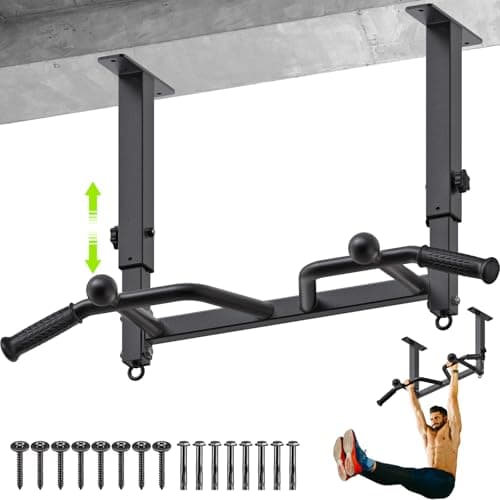
  • Four height settings - drop it clear of a low ceiling or bring it down from a high one
  • Fits 12 in and 24 in stud spacing, and ships with wood and concrete fixings
  • Two rings on the bar take resistance bands or suspension straps

Trade-offs

  • Title says 500 lb, the listing's own feature text says 400 lb - treat 400 as the figure
  • 24 in bar is narrow for wide-grip pull-ups
  • Still a permanent drilled install, whichever height you pick
Value
8
Beginner-friendly
8
Build quality
8
Space fit
9
$89.99 · View on Amazon

#ad · Price as of November 12, 2026 · Affiliate disclosure

OneTwoFit Wall-Mounted Pull Up & Dip Station
06
Best wall mount

OneTwoFit Wall-Mounted Pull Up & Dip Station

ONETWOFIT

7.9

Pull-ups, dips and leg raises off one wall bracket - as long as the wall is concrete or brick, which the listing is explicit about.

Capacity
440 lb (per listing feature text)
Assembled size
38.8 x 31.5 x 88.2 in
Wall type
Concrete or brick ONLY
Fixings
4 x 7 mm suspension anchors
Product weight
9.3 kg

What we like

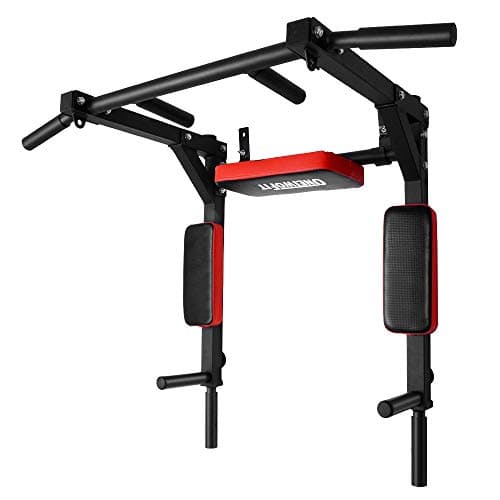
  • Pull-ups AND dips from one bracket, with no floor footprint at all
  • Padded back and arm cushions, so hanging leg raises are actually comfortable
  • Multi-grip bar on a frame that stands 31.5 in off the wall - room to swing

Trade-offs

  • The listing says concrete or brick only, NOT drywall or plaster - that rules out most US interior walls
  • Title says 460 lb, the feature text says 440 lb - treat 440 as the figure
  • Needs a hammer drill and a 12 mm masonry bit you may not own
Value
8
Beginner-friendly
6
Build quality
8
Space fit
10
$99.99 · View on Amazon

#ad · Price as of November 12, 2026 · Affiliate disclosure

04

How to choose

Five mounting methods, and what each one costs you

Read this section before you look at a single price. It is the whole decision.

  • Doorway clamp (no drilling). Fits in the door frame and holds by friction and leverage. Nothing permanent, nothing to install, comes off in seconds. Requires a solid wood frame of the right width - and this is where it fails, because plenty of modern frames are hollow or MDF. Also: your hands are in the doorway, so a tall person clears the floor but not the frame.
  • Free-standing frame (no drilling). A power tower stands on the floor and holds your weight because it is wide and heavy. No holes, adjustable height, and it usually does dips and knee raises too. The cost is floor area it never releases, and the capacities tend to be the lowest here because the frame has to resist tipping.
  • Joist mount (drilling into timber). A short bar bolted straight to a floor joist or ceiling beam. Cheap, rigid, invisible when not in use, zero floor and zero wall footprint. Needs exposed joists - a basement or a garage - or the confidence to find them through a ceiling. Permanent.
  • Ceiling mount (drilling into timber, away from the wall). Same idea with risers that hold the bar out in open space, so you get full range of motion and nothing to bang your knees on. The compatibility question is joist spacing: US joists are commonly 16 in or 24 in on center, and most mounts fit only one. Needs ceiling height, because the bar hangs below the joist.
  • Masonry wall mount (drilling into concrete or brick). Highest capacity, zero floor footprint, usually adds dips. And the hard limit: listings for these are explicit that drywall and plaster are not acceptable. If your interior walls are stud and board, this category is closed to you.

How to choose a pull-up bar is the long version of this, and wall-mounted vs. freestanding applies the same logic to racks.

What the published numbers mean, and where they disagree

Published figures from the makers' own listings - lower figure used where a listing contradicts itself

PickMountPublished capacityBar / spanDrilling?
Sportneer doorwayDoor frame clamp440 lb29.5-37 in adjustableNo
SPORTSROYALS towerFree-standing360 lb44 x 38 in baseNo
Fitarc joist mountTimber joist440 lb23.2 inYes
Ultimate Body PressCeiling, 16 or 24 in joistsNot published42 in spanYes
SELEWARE ceilingCeiling, 12 or 24 in studs400 lb24 inYes
OneTwoFit wallConcrete / brick only440 lb38.8 in wide frameYes

Three honest notes on that table, because the listings are not consistent and you deserve to know which number we trust.

Two listings contradict themselves. The OneTwoFit title says 460 lb while its own feature text says 440 lb. The SELEWARE title says 500 lb while its feature text says 400 lb. We have published the lower figure in both cases and flagged it in the cons, because a capacity you are relying on should be the conservative one.

One listing publishes no capacity at all. The Ultimate Body Press ceiling mount - which is otherwise the best-engineered pick here - does not state a weight rating anywhere in its listing. That is a genuine gap and we have not filled it with a guess. It is still ranked highly because the reversible-riser design solves the joist-spacing problem nothing else here solves.

Capacity is rarely the binding constraint anyway. A 200 lb person doing strict pull-ups loads a bar with roughly their bodyweight plus a modest dynamic factor. The figures here are 360 lb and up. Where it starts to matter is weighted pull-ups - add a weighted vest or a dip belt and the margin shrinks fast.

Measure these three things before you order

  1. Ceiling height where you will hang. You need your full standing reach plus about 6 in of clearance to hang straight without touching the floor, and a ceiling mount eats into that - the Ultimate Body Press hangs 14 in below the joist. In a short room, the adjustable-height picks (the SELEWARE mount and the power tower, which spans 57 to 83 in) are the only ones that work. Our low-ceiling equipment page ranks the rest of the room on the same basis.
  2. Bar width against your shoulders. Two picks here are 23-24 in bars, which is narrow - fine for chin-ups and close grip, no true wide grip. The 42 in span on the ceiling mount is a genuine wide grip. If wide-grip pull-ups are the reason you are buying, this is the spec to read, not the capacity.
  3. What is actually behind the surface. Not what you assume: what a stud finder or a drilled test hole tells you. Most US interior walls are stud and drywall, which rules out the masonry wall mount entirely. Basements and garages usually have exposed joists, which makes the joist mount the cheap, obvious winner.

Who each pick is for

  • Sportneer doorway bar - you rent, or you want zero commitment. Adjusts 29.5-37 in, 440 lb published, two large PVC friction pads and a dual gear lock at each end, and independent ASTM and EN957 certification. Needs a solid wood frame in that width range. The listing warns paint may lift on removal, so test a small area. We review it at Sportneer pull-up bar.
  • SPORTSROYALS power tower- you cannot drill but you have floor space, or you want dips and hanging knee raises from the same frame. Bar height adjusts across 8 levels from 57.09 to 83.07 in, which makes it the most ceiling-flexible pick here, and there is a 5-position backrest. 360 lb is the lowest capacity on this page and the 44 x 38 in base is the biggest footprint. Note the listing claims a “9.8 square inches” footprint, which is clearly a typo - go by the base dimensions.
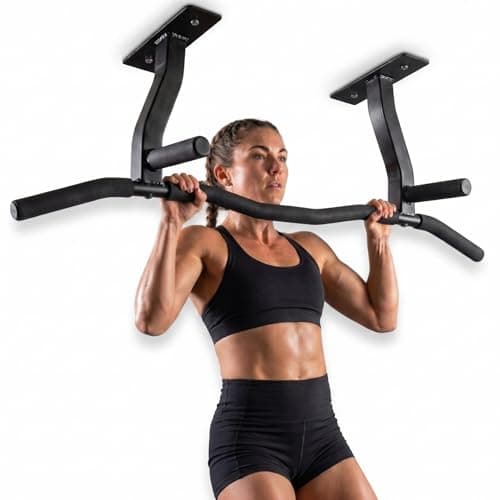
  • Fitarc joist mount - you have exposed joists and you want the cheapest bar that will not budge. 440 lb published on a dual support structure, four foam grips, and it costs less than a pair of dumbbells. The bar is 23.2 in, so no wide grip, and it sits tight under the joist - a tall lifter will tuck their knees. Timber only.
  • Ultimate Body Press ceiling mount - the best-designed pick here, and the one that solves the compatibility trap. Its patented risers reverse to fit below 16 in floor joists or 24 in ceiling joists, so it works in both common US framings. 42 x 42 in assembled with four angled grip positions in high-density foam, mounted clear of the wall for full range of motion. The listing publishes no weight capacity, and it hangs 14 in below the joist.
  • SELEWARE 24 in ceiling mount - your ceiling is awkward. Four adjustable drop heights is unique on this page: lower the bar away from a high ceiling or keep it tight under a low one. Fits 12 in and 24 in stud spacing, ships with wood and concrete fixings, five grip positions including a ball finger grip, and two rings that take bands or suspension straps. Treat the capacity as 400 lb, not the 500 lb in the title. 24 in is narrow.
  • OneTwoFit wall-mounted bar and dip station - you have a concrete or brick wall and you want two stations off one bracket. 440 lb published, stands 31.5 in off the wall so there is room to swing, padded back and arm cushions that make hanging leg raises comfortable, no floor footprint at all. The listing is explicit: concrete or brick only, NOT drywall, plaster or cavity walls. Needs a hammer drill and a 12 mm masonry bit.

What we left off, and why

No rack-mounted bars. Every power rack and most squat stands already have a pull-up bar across the top, which is the best bar in the house: high, wide, and rated for the frame. If you are buying or already own a rack, you do not need anything on this page - see best power racks and squat stands and pull-up bar vs. power rack, which settles whether a bar is enough on its own.

No doorframe hook-over bars - the type that rests on the moulding above the door and relies on your weight pulling it against the frame. They work, they are cheap, and they damage trim and come loose in a way that a clamped bar does not. The doorway pick on this list is the version of that idea we are comfortable recommending.

No four-figure wall rigs, and no gymnastic ring setups as a bar substitute. Rings are excellent and genuinely harder; how to choose gymnastic rings covers them, and they still need something to hang from - usually one of the mounts on this page.

And no bars we could not confirm in stock. Two otherwise good joist mounts showed only a handful of units left on the day this page was written, and a roundup pick that is gone next week is not a recommendation.

Buy a band with the bar

Most people buying their first pull-up bar cannot do a pull-up. That is normal, and it is also why so many bars end up unused: the exercise has no scaled version unless you create one.

A single looped resistance band, hooked over the bar with a knee or foot in it, takes enough weight off that you can do real reps with real range of motion from day one - and then you move to a thinner band. It costs a fraction of any bar here. Our how to choose resistance bands guide covers which to get, and how to do a chin-up is worth reading too - chin-ups are easier than pull-ups for most beginners, and every bar here does both.

Once you can do sets of eight, the problem reverses and you need to add weight. That is where a weighted vest or a dip belt comes in, and where the published capacities in the table above finally start to matter.
05

Common questions

What is the best pull-up bar for a home gym?

It depends on one thing: what you can drill into. If you rent, a no-drill doorway clamp bar fitted to a solid wood frame is the answer. If you cannot drill but have floor space, a free-standing power tower adds dips and adjusts in height. If you have exposed joists in a basement or garage, a joist mount is the cheapest and most rigid option by a wide margin. Masonry wall mounts have the highest capacity but need genuine concrete or brick.

Are doorway pull-up bars safe?

The good ones are, within their stated limits. The pick on this page publishes a 440 lb capacity and independent ASTM and EN957 certification, which is more than most bars in any category publish. The conditions matter though: it needs a solid wood frame within its 29.5-37 in width range, and it is not suitable for hollow, MDF or plastered frames. Check your frame before ordering, and expect the possibility of paint lifting when you remove it.

Can I put a pull-up bar in a rented apartment?

Yes, with either of the two no-drill options. A doorway clamp bar leaves no holes and comes off in seconds, which makes it the standard renter answer. A free-standing power tower also needs no fixings, and it adds dips and hanging knee raises, but it permanently claims a floor area of roughly 44 by 38 inches. Anything that mounts to a wall, joist or ceiling needs holes and is a conversation with your landlord.

How much weight capacity does a pull-up bar need?

Less than the listings advertise, for bodyweight work. A 200 lb person doing strict pull-ups loads the bar with roughly their bodyweight plus a modest dynamic factor, and the bars here publish 360 lb and up. Capacity becomes the real constraint when you add a weighted vest or a dip belt, or if you kip. Treat the stated figure as a ceiling to stay well under, and where a listing contradicts itself, trust the lower number.

What joist spacing do ceiling pull-up bars need?

US framing is commonly 16 inches or 24 inches on center, and most ceiling mounts fit only one of those - which is the compatibility trap in this category. One pick on this page uses reversible risers that flip to fit below 16 inch floor joists or 24 inch ceiling joists, and another fits 12 inch and 24 inch stud spacing. Measure your joists before ordering, and remember the bar hangs below them, so check your ceiling height too.

Can you mount a pull-up bar on drywall?

No. Wall-mounted pull-up bars put a large leveraged load on their anchors, and drywall, plaster and cavity walls cannot carry it - the listing for the wall mount here states that explicitly and names concrete or brick as the requirement. If your interior walls are stud and board, your options are a joist or ceiling mount into timber, a doorway clamp bar, or a free-standing frame.

Do I need a pull-up bar if I have a power rack?

Almost certainly not. Nearly every power rack and most squat stands have a pull-up bar across the top, mounted high, usually wider than any standalone bar here, and rated for the frame's full capacity. The one case for adding a separate bar is wanting to train in a different room, or wanting a neutral or angled grip the rack bar does not offer. Otherwise, save the money for plates.

What if I can't do a pull-up yet?

Buy the bar and a looped resistance band at the same time. Hook the band over the bar, put a knee or foot in it, and you can do full-range reps immediately - then move to a thinner band as you get stronger. This is the single reason most first pull-up bars get used instead of stored. Chin-ups, with palms facing you, are also easier than pull-ups for most beginners, and every bar on this page does both.

Read next

→

A bar and a band is a real upper-body gym.

Add a bench and some load and you have the whole thing. The $1,000 Build shows the order to buy in, with a running total.