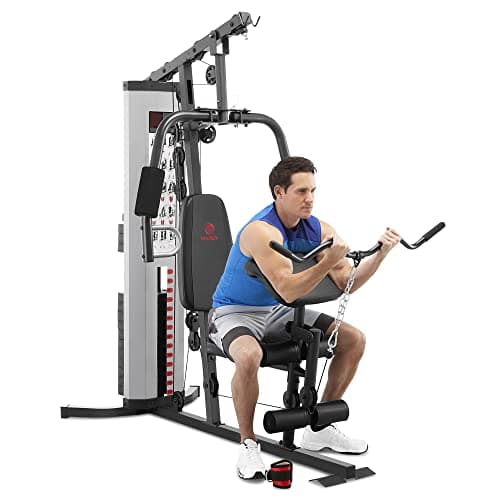
Rods vs. a steel stack: the one real difference
This is the part that matters and the part most comparisons skip, so here it is plainly. A weight stack gives you roughly constant resistance through the rep - a 100 lb plate weighs 100 lb at the bottom and 100 lb at the top. A bent composite rod gives you rising resistance: the further you bend it, the harder it pushes back.
Neither is wrong, and both build muscle. What changes is where the exercise feels hard. On a stack, a chest press is hardest off the chest, which is where a barbell press is hardest too - so the strength transfers more directly to free weights. On rods, the press gets harder as you extend, so the top of the rep is the hard part. People who have trained on both usually describe rods as feeling “springy” and a stack as feeling “like weights”, which is exactly what they are.
Two practical consequences, and they cut in opposite directions:
- Rods are quieter and lighter to live with. No clanking stack, far less mass to get up a flight of stairs, and nothing that can be dropped on a foot.
- A stack is a known quantity. 150 lb on the pin is 150 lb, which makes progress easy to track and comparable to anything else you lift. Rod resistance is rated as an equivalence, not measured at a fixed point in the rep.
If you want the full argument about guided machines versus free weights at all, our weight machine vs. free weights at home guide treats it as a purchase question, and free weights vs. machines covers the training side.
The five alternatives against the original
Two things worth reading carefully. First, the resistance numbers are not directly comparable: 210 lb of rod resistance is a manufacturer equivalence rather than a weight measured at a point in the rep, while 150 lb of stack is 150 lb of steel. Treating those as the same unit would be dishonest, and we are not going to convert between them - no published figure supports a conversion. Second, every alternative here is deeper than the Bowflex at 68 to 75 inches, and the MKM-81010 is 85 inches tall, which is the one machine a standard basement ceiling can rule out.
The resistance ceiling, in both systems
This is the most common reason anyone leaves either system, so it deserves its own section.
On a Power Rod machine, the upgrade path is to buy more rods - Bowflex’s page states 210 lb as standard, rising to 310 or 410 lb with an accessory purchase. That is a real path, and it costs money each step.
On a selectorized stack, there is no upgrade path at all. 150 lb is 150 lb for the life of the machine, and you cannot add plates to it the way you can to a barbell. That is the honest weakness of every stack machine on this page, and it is why the 200 lb MKM-81010 is worth the premium if you already train. Expect pulldowns and rows to reach the top of the stack well before a chest press does.
On a power cage, the ceiling is simply how many plates you own, which is why the JEEKEE is on this page despite being a different kind of object. If the thing you disliked about a rod gym was hitting its top end, a cage removes the question permanently - at the cost of having to learn the lifts. Best all-in-one squat racks ranks that class properly, and best home gym machine under $1,000 puts a stack machine and a barbell gym side by side at the same budget.
Who each pick is for
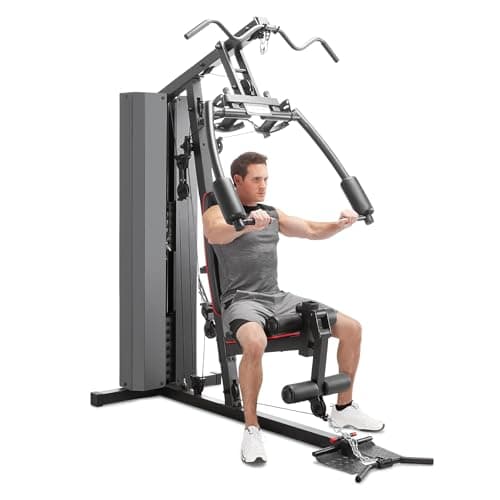
- Marcy MWM-988 - you want the same machine experience in steel. Seated, guided, press arms and a leg developer, 150 lb on a pin, at a fraction of a new Power Rod gym.
- Marcy MKM-81010 - resistance is why you are looking. 200 lb of stack, the most here. Check that your ceiling clears 85 inches first.
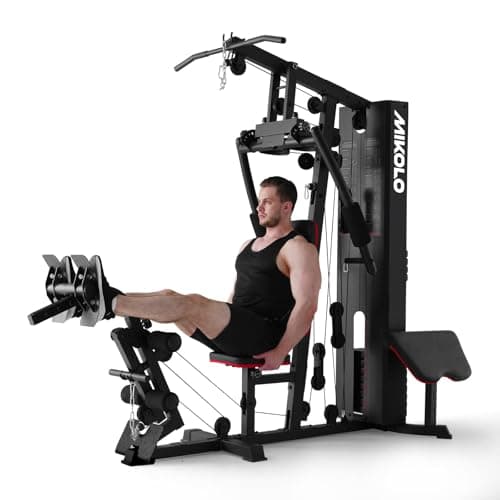
- Mikolo HGS Pro - you want the longest exercise list. Three pulley heights plus a leg press off a 152 lb stack, a lifetime frame warranty, and the narrowest footprint of the full-size machines at 36.3 inches.
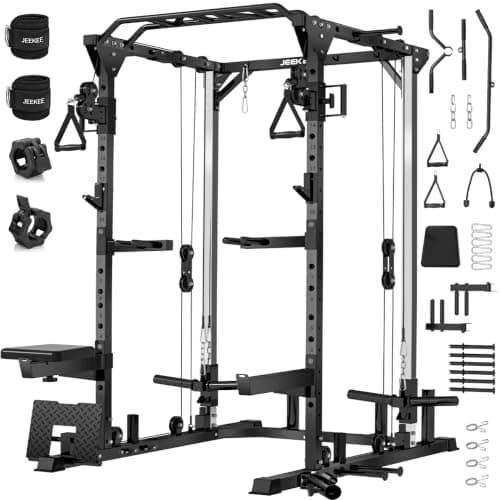
- JEEKEE power cage - you are ready to leave machines behind. Squat and bench a real barbell inside a 2,000 lb rated cage, and keep cable work via independent dual pulleys. The ceiling is however many plates you buy.
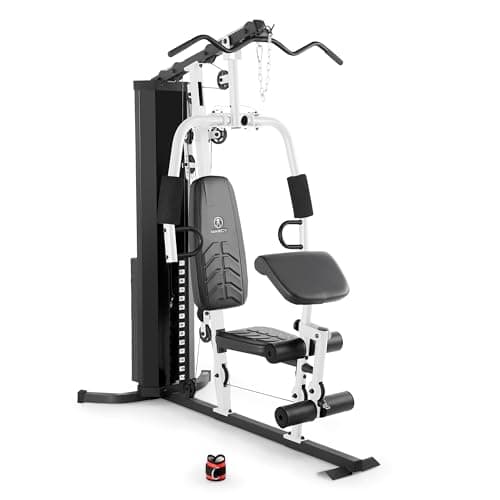
- Marcy MWM-8147 - the budget pick. The same 150 lb as the 988, plus a published 300 lb user capacity and the lat bar and ankle strap already in the box.
What we left off, and why
No buy link for the Bowflex machine itself, anywhere on this page. It is not in our product registry - we have not resolved a live listing for it and we do not earn anything if you buy one - so it appears purely as the baseline. If the Power Rod gym is what you want, Bowflex’s own site is the place to buy it.
No converted resistance figures. You will find pages claiming that X lb of rod resistance “equals” Y lb of stack. No published source supports a conversion, the honest answer is that the two systems load the rep differently, and we have left both numbers in their own units rather than inventing an exchange rate.
No Power Rod or band-based competitors. If rising resistance is what you liked, the answer is a Bowflex, and swapping it for an imitation of a Bowflex is not an alternative worth writing about. Resistance bands are the cheap version of the same physics, and they are ranked on best resistance bands for a home gym.
And no machine whose price we could not read. One all-in-one stack machine we rank elsewhere showed no live offer when we last checked, so it is not here - a comparison page needs a real number in every row.