The four things you are actually comparing
- The rack itself.Force USA publishes 11-gauge steel, 3 x 3 inch uprights and 1 inch holes every 2 inches on the M20, which is a commercial pattern and the reason their attachment range fits so broadly. Our picks run 50 x 50 mm tube at 1.5 mm wall with frame ratings of 1,500 to 2,000 lb. For a beginner's loads those are strong frames; they are not the same steel standard, and a 3 x 3 commercial upright also takes third-party attachments that a 50 mm metric tube will not.
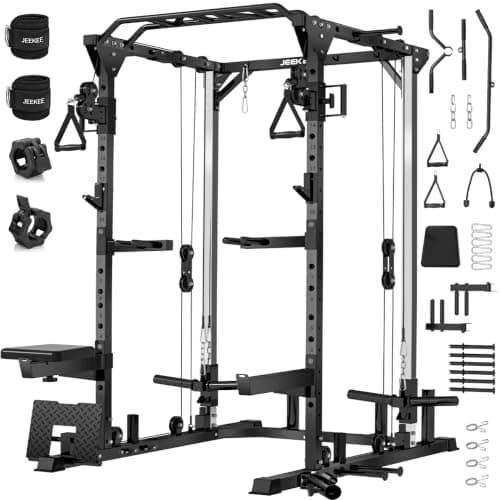
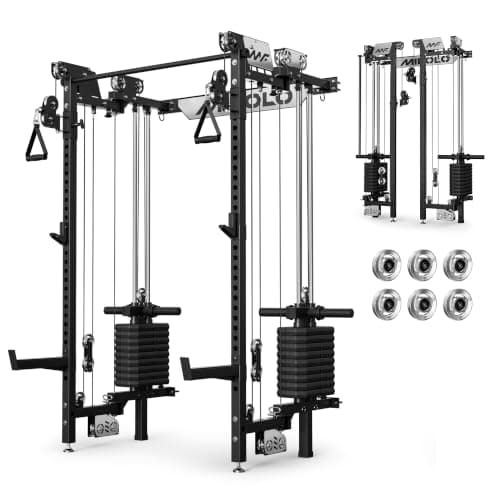
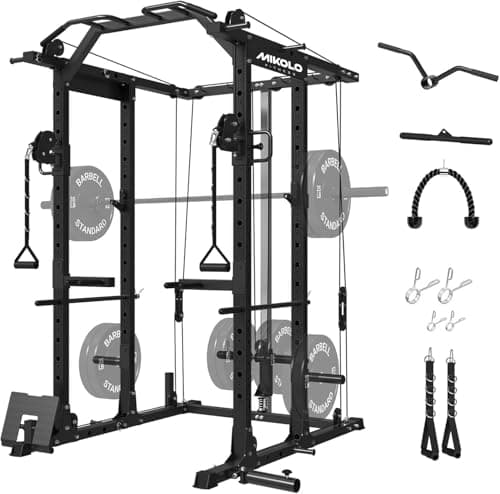
- Independent pulleys.Force USA's Freestyle arms mount to the front uprights and move through every plane; the C10 is built around a 6-pulley station. Two of our picks - the JEEKEE cage and the Mikolo folding wall rack - have genuinely independent dual pulleys, which is the one spec that separates a functional trainer from a lat tower. The K6 and the S11 have a high pulldown and a low row rather than two free arms.
- Resistance choice and ratio. This is where our registry cannot match them. Force USA lets you pick a pin-loaded stack or plate loading and switch the cable ratio between 2:1 and 1:1 on the fly. Nothing we rank does that. Two of our picks have a fixed pin stack (100 lb and 152 lb), three are plate-loaded, and none has a switchable ratio.
- The attachment ecosystem. Force USA sells a leg press, a swivel seat, dip handles, pull-up handles and a low-row footplate for the same frame. Our picks ship with what is in the box - the JEEKEE lists 20-plus attachments and a removable lat seat, the K6 includes its footplate - and there is no catalogue of first-party add-ons behind them.
Two of those four are matchable at a fraction of the price. Two are not, and a reader deciding to spend four figures deserves to know which is which.
What each alternative covers
Read the third column against what Force USA publishes. If the independent pulley arms are the thing you want, your shortlist is two items long: the JEEKEE cage and the Mikolo folding wall rack. If what you want is no plates to buy, it is the Mikolo HGS Pro at 152 lb on a pin or the folding rack at 100 lb. Nothing here switches cable ratio, and nothing here is 3 x 3 inch 11-gauge steel.
Also worth stating plainly: the Mikolo folding wall rack bolts into wall studs. That is permanent, it is not a renter's purchase, and it is the price of a frame that folds to a published 3 square feet.
Who each pick is for
- Mikolo K6 - most people replacing an all-in-one on a home budget. A real cage you can squat and bench inside, 41 by 60 inches of internal space, a 1,500 lb frame rating and a cable system with a footplate for low rows. Plate-loaded, so budget for plates if you own none - our plates ranking covers that.
- JEEKEE cage with dual-pulley crossover - the pulley arms are what you came for. Independent dual pulleys rated 500 lb on a 2,000 lb frame of 50 x 50 mm commercial-grade tube, with 20-plus attachments and a removable lat seat cushion in the box. This is the pick that gets closest to the functional-trainer half of a Force USA in substance rather than in marketing.
- Mikolo folding wall-mounted rack with 100 lb stack - the room has to go back to being a room. Independent dual pulleys across 28 heights with a 2:1 ratio and a real 100 lb selectorized stack, folding to a published 3 square feet from 9.5 open. Bolts into studs - permanent, and the most expensive pick here.
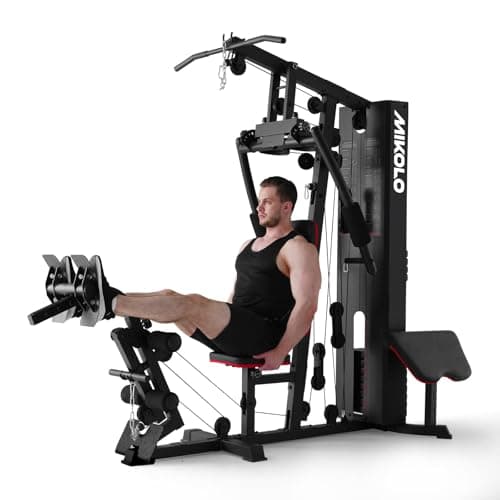
- Mikolo Home Gym Station (HGS Pro) - you want to buy nothing else ever. A 152 lb pin stack with high, mid and low pulleys: no plates to buy, store or load. What it is not is a rack - there is no cage to squat or bench inside, which is a real gap against every Force USA trainer and the reason it is ranked fourth rather than first.
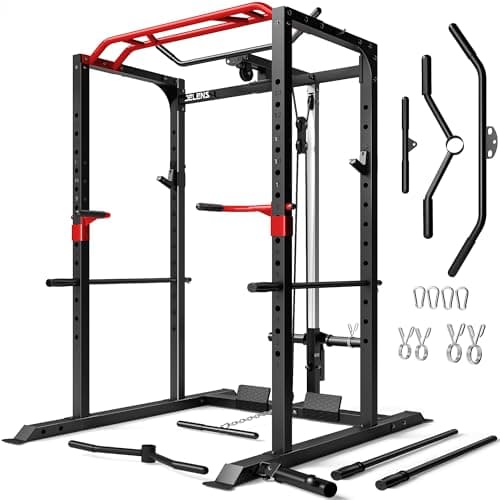
- JELENS S11 - the budget pick, and a lot of frame for the money. 2,000 lb rating on 50 mm tube, upper and lower pulleys, 13 laser-numbered positions and a published 12.5 sq ft footprint. Single cable path rather than independent arms, which is the honest limit at this price.
What we would tell a beginner reading this page
If you are shopping a Force USA trainer as your firsthome gym, the most useful thing we can say is that an all-in-one is rarely where a beginner's money works hardest.
A rack with safeties, a barbell, plates and an adjustable bench covers squats, bench press, overhead press, rows and deadlifts - the five lifts that build most of the strength most people are after - and has a far higher load ceiling than any cable stack. That combination is what the $1,000 home gym build costs out line by line, and it is the honest comparison to a four-figure trainer.
Where an all-in-one genuinely wins is cable work and a guided feel: pulldowns, crossovers, pushdowns and rows with constant tension, which free weights cannot replicate, plus the option of pressing without a spotter. If that is what you want, the question is how much frame you need around the cables - best functional trainers ranks the dual-pulley machines on their own, and best cable machines under $500 is the price-capped version.
Three cases where buying Force USA is right
- You want a commercial upright standard. 11-gauge 3 x 3 inch uprights with 1 inch holes every 2 inches is a pattern a huge third-party attachment market is built around. Nothing we rank uses it, and if you intend to keep adding to the frame for a decade, that compatibility is worth real money. Our power rack attachments page explains why upright size decides what you can bolt on.
- You want a switchable cable ratio.Force USA's Dual Force Twist Lock changing between 2:1 and 1:1 is not a feature anything in our registry has, at any price.
- You want one frame to do everything including a leg press. Their store sells a G3 leg press attachment and plate-loaded Ridgeline machines for the same ecosystem. We hold no verified leg press listing and will not invent one.
In all three cases, go to forceusa.com for current pricing on the trainer and the attachments you would eventually add - we deliberately do not reproduce their figures.
What we left off, and why
No buy link for Force USA, anywhere on this page. We hold no verified listing for any of their frames, and a page that cannot stand behind the listing has no business sending you to one.
No price for Force USA or its attachments. Their store publishes those and they change; this site reads its own prices from a live layer and never types one in by hand.
No claimed equivalence between a 100 lb or 152 lb stack and a Force USA stack, and no conversion between a plate-loaded pulley at 2:1 and a pin stack at 1:1. Cable ratios change the weight you feel, the published figures describe different arrangements, and no source supports an exchange rate. The same rule applies here as on our Tonal page and our Bowflex home gym page.
No leg press, hack squat or isolation machine. Force USA sells several; our registry holds no verified listing for any of them, and we do not invent a product to fill a slot.
And no invented specs. We have not assembled or loaded a Force USA frame. Every figure attributed to them above is a quotation from their own store, dated, and every figure attributed to our picks comes from the live listing.